Water and The City

Can Colorado’s Water Supply Sustain Urban Growth?

Posted by Dean Saitta on August 09, 2012
Water and The City / 1 Comment

This is one of the big questions at issue in the Intercultural Urbanism blog posts archived under Water and the City.  It’s also the question I brought to a half-day focus group about water supply and land use held in Denver last month. The event was sponsored by the Colorado Water Institute and The Keystone Center.  These entities have joined forces to tackle what they call the “dilemma” of water use in Colorado. At the heart of the dilemma is this: a state’s economic viability often depends on growth, yet water—as an obviously key requirement for economic growth—is a precious resource that can’t be harvested willy-nilly.  Complicating the dilemma is the fact that not everyone who deals in water supply and land use in the state is on the same page.  Land use planning is typically a local governmental concern, while water planning and allocation occur on multiple local, state, and federal levels.

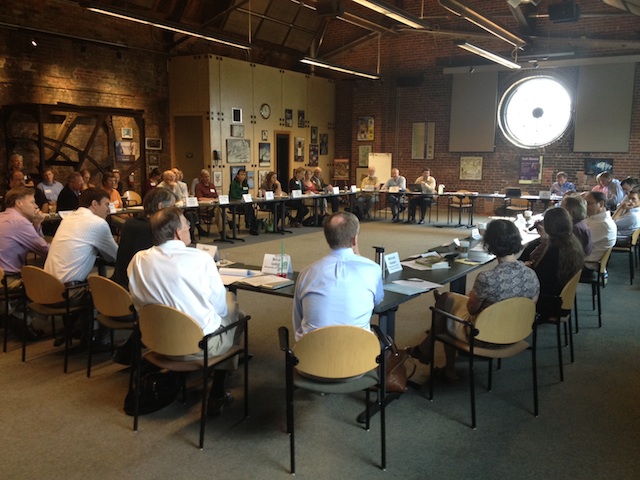
The event was held July 10 at the REI flagship store on Platte Street.  It was attended by about 35 people including water providers, water engineers, water lawyers, state legislators, city officials, health specialists, conservationists, developers, academics, and even a Colorado Supreme Court justice.  The question before the assembly was whether to establish a “Colorado Water and Growth Dialogue for Action” group that would integrate a broad array of theoretical, practical, and geographical perspectives on Colorado water planning and land use.  This initiative would explicitly play off of a consensus achieved at the July 2011 Colorado Water Workshop in Gunnison calling for greater dialogue between water supply managers and land use planners, and a “test” dialogue that occurred in March 2012 at the annual Rocky Mountain Land Use Institute meeting (a summary of which is here).

It was a pleasure to be included in the water and land use focus group.  The informal roundtable format allowed individuals to contribute as the spirit moved.  The result was a stream-of-consciousness discussion that brought to the surface many interesting issues.  The downside was that, because of time constraints, none of the issues could be discussed at-length or in-depth.  Still, I got a sense of how my question might be answered.  The answer seemed to be that yes, a sufficient water supply exists in Colorado to support growth without any net increase in water consumption even beyond the year 2050.  Indeed, one expert suggested that water supply gap is not the appropriate term for what bedevils us. Rather, it’s a structural deficit that has some people not getting what they need. I took this to imply that the problem is not one of supply but of distribution or allocation (although no one would be foolish enough to suggest that water conservation should not be a priority).

A spirit of pragmatism permeated the meeting room.  Growth in the West has rarely been constrained by water availability.  Growth is going to happen.  Hundreds of companies are targeting Colorado as a business location. Millennials want to move into the state and, with aging Baby Boomers, want to live in walkable urban cores and suburbs.  The question, then, is how do we grow?  Densifying cities and other settlement clusters is one obvious answer.  As one attendee put it, we need to replace “plants with people.”  But that solution is problematic.  Not all citizens like or want density, and we don’t know how much water savings is achieved by densifying.   There’s also the question of what water-saving density would look like in terms of settlement form.

Water Supply and Land Use Focus Group, 10 July 2012, REI Denver (Todd Bryan, The Keystone Center)

A couple of informed predictions about housing got my attention.  One is that by 2050 between 50-75% of existing Front Range housing stock will have been replaced.  Moreover, detached housing costs will become increasingly prohibitive for families, thus further pushing municipalities toward different ways of housing people.  This situation presents an opportunity for exploring new ways of looking at how we address water and growth.  Consequently, I  found myself thinking about this challenge from an intercultural perspective.  Will housing stock replacement be sensitive to urban immigration trends and increasing ethnic diversity and difference?  Will developers and home builders consider the alternative cultural values that govern household size, configuration, and water use?   Or will the touchstone for redesign be the norms and values of a white, middle-class, Western demographic?  And, if education about water use efficiency is key to remedying what some called “dysfunctional cultural behavior,” what would educating a culturally-diverse target population look like?  How ethnic diversity affects urbanism is still an afterthought even in more progressive, sustainability-conscious urban planning circles (e.g., see the March 2012 issue of Colorado Urbanist, page 22).

At the end of the day there seemed to be some consensus on a couple of points.  One is that we need a “paradigm change” in the way we think about water and growth. The new paradigm should not set up false choices or dichotomies such as growth vs. no growth.  Another is the dichotomy between agricultural and municipal water use.  Support was expressed for the idea that water can be successfully moved between these sectors, and that moving water from agriculture to the city won’t necessarily devastate agriculture (although legislators from rural areas might disagree).  Still another was the dichotomy between Colorado’s Front Range and Western Slope. A good bit of the state’s water is redirected from the Western Slope to the Front Range, but the latter might end up having something to teach the former about effective water planning and use.

Certainly there was a greater consensus around the idea that we need to get the professionals who deal with water out of their institutional “silos” and into a more productive conversation with each other. Plus, new people need to be brought into the conversation.  Who’s missing from the conference table that should be there?  Answers include economists, landscape architects, realtors, homebuilders, someone representing agriculture, and citizen planning commissions.  The representative from Denver Water cheekily suggested that, at the very least, we need fewer water people at the table!   Also needed is a will among all parties to work together in ways that don’t simply re-create wheels or yield the same shopworn policy recommendations.  To their credit the Colorado Water Institute and Keystone Center are undaunted, and will proceed to develop a structure and a logistics for continuing the dialogue about water planning and land use in Colorado.

Watering the Cosmopolis

Posted by Dean Saitta on April 18, 2012
Sustainability, Urban Studies, Water and The City / No Comments

I use the concept of cosmopolis in Leonie Sandercock’s sense, referring to a city that’s developed in ways sensitive to cultural diversity and its wider societal benefits (e.g., enhanced vitality and creativity). In a recent post I noted that the sessions devoted to “Wilderness City” water planning at the Rocky Mountain Land Use Institute’s 2012 Conference seemed to take as self-evident the meaning of terms like “public”, “values”, “housing” and, especially, “culture.” Proposed solutions to urban “hydro-sustainability” problems were informed by a Western worldview that sees water as a scarce economic good or commodity.  Many of the discussions were framed in terms of white, middle-class consumer values and behavior, and the settlement preferences of Generation X and Generation Y.  (Some of the RMLUI conference talks and slide shows are posted here).    In short, it  wasn’t clear that conference presenters were thinking about the city as a cosmopolitan enterprise.

Resources can be valued on something other than economic, utilitarian grounds, and urban demography can be described in terms other than Gen X and Gen Y.  It’s an anthropological taken-for-granted that cultures value and assign meaning to water differently.  For many cultures water is a spiritual as well as an economic good.  For some it’s a basic human right.  Minimally, water is integral to many if not most domains of society.  The different meanings and structural relationships of water need to be recognized by urban planners and basic service providers.  Daily household demands for water are also cross-culturally variable.  Thus, it’s problematic to assume that any particular pattern of water consumption is “typical”  for an urban population generally.  Water management issues are as much cultural—or intercultural—as technical.   While particular Non-Western notions of water as sacred can easily dovetail with a Western ethos of environmental sustainability, particular regulating strategies like water metering, recycling, budgeting, etc. can conflict  with particular cultural values identifying water as sacred and a basic human right.  Certainly, management strategies like differential pricing based on intensity of use can easily discriminate against some cultural groups and contradict broader civic commitments to  tolerance and inclusion.

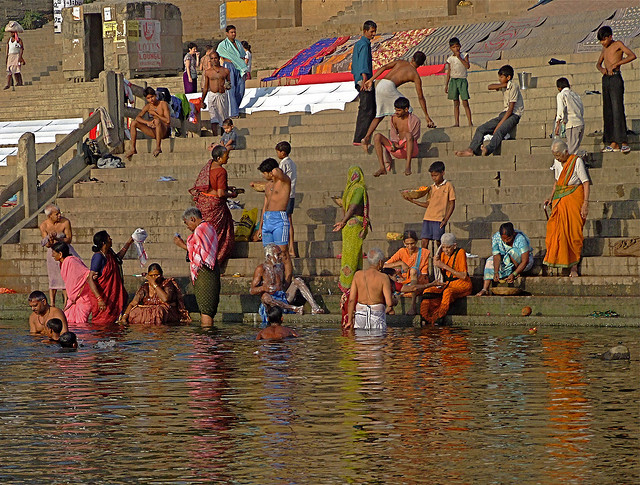
Ritual Bathing in the Ganges River, India

Interest in the cultural values that shape water use has been growing since at least 2000.  In that year UNESCO organized a session on “Water and Indigenous People” at the 2nd World Water Forum at The Hague.  The organizing theme for the 3rd World Water Forum in Kyoto in 2003 was “Water and Cultural Diversity.”   Even with these significant interventions the Cultural Diversity and Water Sustainability “Session Situation Document” for the 5th World Water Forum in Istanbul in 2009 noted that “interdisciplinary and systemic analysis of the relationships between cultural diversity and water, and their implications for sustainable management of water resources, are still lacking.”

Still, there’s been some notable work establishing the difference that culture makes in affecting water use.  A collection of case studies from the Environmental Evaluation Unit at the University of Cape Town–A Desktop Study on the Cultural and Religious Uses of Water describes various rituals and ceremonies in traditional African religions as well as religions like Islam and Hinduism in which water plays a central role.  Some of these rituals require facilities for water pooling. In other ceremonies water has to be running.  In still others the water must be pure and neither tap nor recycled waste or “grey” water will suffice.  Some of these rituals clearly have implications for urban design and architecture.  Interestingly, the report’s authors note that these rituals and ceremonies have been gaining popularity in urban as well as rural areas. Thus, the widely noted world-wide migration of people from country to city is not likely to change cultural practices involving the use of water.

Faucets for performing ritual ablutions, Istanbul

London–the quintessential cosmopolis–looks to be ahead of the curve in researching cultural diversity and water use in ways that can inform management decisions.   A 2006 paper reporting studies of water flows in District Metered Areas (DMAs) in number of British cities noted “startling differences” in water use patterns that are related to religious and cultural practices.  Characteristic patterns are found principally in Jewish and Muslim communities.  For example, there’s a Jewish peak on Friday afternoon in anticipation of Shabbat.  Within Muslim communities intense washing precedes daily prayers, especially during the month of Ramadan.  Prescriptions in Islam against wasting water align with Western conservation values but there are clearly times when unusual amounts of water must be available for various practices.  The importance of using running water in a cultural practice of “washing up” is also a characteristic of Hindu groups. In this case, however, the practice links not to religious belief but rather to culturally-inscribed dietary practices: the high fat and oil content of Indian cooking.  In short:

The overwhelming evidence is that religion [and culture generally] has a fundamental bearing not only on how people use water but also on how they think about water. The overall conclusion is that it would be extremely unwise to exclude religion or ethnicity as parameters in any further research into understanding domestic water demand…Understanding such fundamental differences caused by religious practice may be critical to the planning and design of network water systems.

Hindu ritual involving water in Alagarkoil, near Madurai, Tamil Nadu, India

A 2007 report– Cultural Diversity and Sustainable Water Management in Greater London: The Research Agenda–  summarizes and extends work like that described above.   It’s very aggressive in critiquing the implicit assumption of a “white, Christian norm” of water consumption that far too often (and perhaps unconsciously) informs water management strategies.  It’s likely that such a norm also pervades other assumptions about, say, cultural standards of cleanliness.  While there are some  clear convergences between “West” and “Other” in the ways that water is valued, the report concludes that there’s “little to suggest that valuations of water in any faith systematically translate to a tendency to water conservation.” Effective and sustainable  demand management strategies require beginning with diversity in cultural identities and values, and especially with diversity in the everyday practices, habits, and routines of the consuming population.

Water management for urban sustainability in Cosmopolis–like management of the built environment generally–must accommodate cultural diversity. If it doesn’t it risks ensuring that urban and exurban infill developments remain enclaves for middle class whites; i.e., homogenous communities that are conceivably “gated by other means.”

Water and The Wilderness City

Posted by Dean Saitta on March 06, 2012
Sustainability, Water and The City / No Comments

My title comes from that of the Rocky Mountain Land Use Institute’s 21st annual conference held last week at The University of Denver’s Sturm College of Law.  “The Wilderness City: Nature, Culture, and Economy in the Next West” was framed in terms of the  following theme:

The Rocky Mountain West is characterized by majestic peaks, rolling prairies, rugged plains and vast open spaces. At the same time, the West is home to rapidly growing cities like Denver, Las Vegas, Albuquerque, Salt Lake City, Phoenix and Boise, as well as countless small towns trying to remain viable in an increasingly urbanizing region. Interestingly, as urban centers continue to grow, they are seeking to reconnect their local cultures and economies to what remains of their native ecology…“Wilderness Cities” like Vancouver, Canada blend the wild and the urban seamlessly, with skyscrapers and industry nestled up against rain forests, killer whales and coastal mountains. How can a Wilderness City model and other “green” development approaches not only make Western communities vibrant economic centers but also strengthen our connection with the land?

My schedule permitted attending the conference for just one day. I went to two sessions on water that were relevant to an Institute for Enterprise Ethics research grant that I have with colleagues in DU’s Daniels College of Business.  The theme for the water sessions was pitched pretty simply:

The Rocky Mountain West is one of the fastest growing areas of the country and one of the driest. These sessions address the challenges municipalities and regions will face in meeting the challenges of water supply and demand.

The first session was called “Water and Growth: Can We Wrestle With the Paradox?” The paradox in question derives from the fact that growth is necessary to ensure the economic viability of western cities, but this inevitably raises the specter of water shortages.   The panel brought together water supply and built environment planners in a dialogue about whether the  paradox can be solved.   The second session was called “Water Conservation in West: The New Normal.”  Speakers addressed the institutional and practical needs for water conservation in the Western United States.  They identified various techniques being implemented to conserve and reuse water resources, and considered the evolving regulations for water conservation from both land use and water rights perspectives.

Some of the key takeaway messages of the sessions, considered together:

  • Western growth is inevitable, but water is finite.  There are no sources of new supply. This means that water must be diverted and re-allocated intelligently (e.g., from irrigation to other uses), and formerly irrigated land must be managed sensitively (i.e., it won’t return to prairie “on its own”).
  • Creating efficiencies in water conservation is important (e.g., by educating the consuming public and offering incentives to consumers to change their behavior, especially where outdoor water use is concerned), but there are limits to how far conservation can take you.   Panelists and audience members discussed the use of various other “demand management tools” including water pricing measures and stronger water use regulation.  Regarding the latter, there was a powerful sense that water providers needed to  strengthen their authority to regulate water use. Colorado House Bill 08-1141 requiring that developers show that adequate water for their project is in hand before they proceed was cited as an exemplary form of regulation…at least in principle.  Apparently the bill was “watered down” (no pun intended) before it was enacted and thus carries little real clout as regards verification of water supply.   Political term limits for legislators interested in water regulation was cited as another problem. Such limits can derail efforts to enact legislation for more enlightened water use planning.
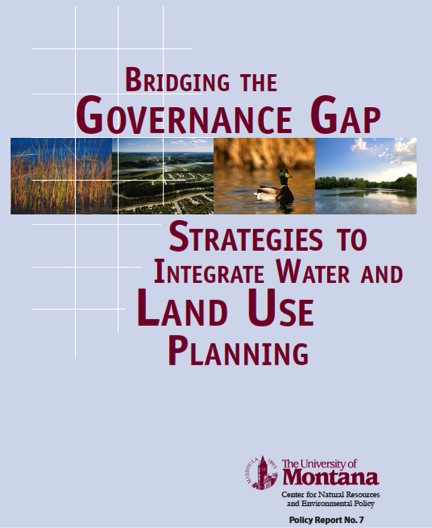
  • It is imperative to better integrate water planning and land use planning.  These can’t continue to be separate discourses. What’s needed is a more holistic approach that balances multiple interests.  Sarah Bates’s University of Montana/Center for Natural Resources and Environmental Policy Report on strategies for integrating water and land use planning was mentioned by a number of speakers as a  blueprint for strategizing in this area.
  • Cultivating extensive partnerships among private developers, water providers, state government, city councils, planning commissions, and other agents (described as “silos” by one panelist) was deemed key to strategizing.  In particular, these entities need to synchronize their planning cycles and cultivate some shared understandings of terms that are commonplace in the water discourse; e.g., “land use”, “water supply”, “reuse”, and “water conservation”.  Right now there is no predictability from one jurisdiction to the next.  One speaker noted that the touchstone for conversations across the silos should be three things that all participants can agree upon: the health, safety, and welfare of citizens.
  • Finally, a view was expressed by some panelists in both sessions that only a serious water crisis will change things here in the West.  The “Code of the West”  emphasizing local control and the sanctity of private property is just too strong and pervasive.  This ethos encourages go-it-alone behavior and works against consensus building.  Unless cities and counties can reach agreement on some common standards for water efficiency (e.g., around the size of front yards and quality of landscaping—the biggest water hogs), and for verifying conservation practices across metropolitan areas the water problem will only perpetuate itself.

Wilderness City (Karlin Real Estate)

The conference speakers were informed and provocative.  I learned a lot that was new and that also reinforced much of what our research team has already discovered about Western water through interviews with various local subject matter experts.  But while plenty of ideas were suggested about what can be done on the water use side of the “paradox”, significantly less was offered on the land use/built environment side.  Specifically how—in the language of the Bates Report—our water footprint can be reduced “through development design and building choices.”  One audience member living in Denver’s Stapleton community broached the issue by noting that development’s use of small lots and xeriscaping.  A panelist in the second session—Harold  Smethills, the developer of Sterling Ranch—gave a comprehensive summary of design and building choices at that most water-conscious of Front Range exurban infill projects. These include high density residential clustering into “urban villages”, exclusive use of grass as an “accent strip” (i.e., as a “throw rug rather than a carpet“), TigerTurf for pets, infrastructural provisions for rainwater harvesting, 37% dedicated open space, gardens instead of golf courses, and 30 miles of hiking, biking, and horseback riding trails.

Certainly, land use and water planning at Sterling Ranch is consistent with the aims of the “Wilderness City.”  The development is tailor-made for a particular demographic: active-lifestyle young professionals on tight budgets looking for an affordable first home, as well as the older “last home” market.  But there are, of course, lots of other urban demographics to be served including those who occupy–either by desire or necessity–the urban core and who have no budgets to speak of.  Addressing the water and design needs of these demographics requires, I think, problematizing other terms that came up in the day’s discussions but whose meaning seemed to be taken-for-granted by conference participants—perhaps because the panels and audiences were ethnically, culturally, and economically homogenous.  These include terms like “public”, “values”, “housing” and, especially, “culture.”  I’ll take up this topic in a separate, soon-to-follow post.

Peak Water, Urban Sustainability, and the ‘New West’

Posted by Dean Saitta on December 02, 2011
Denver, Sustainability, Urban Studies, Water and The City / No Comments

Water is a key resource constraint in urban development, especially here in the West.  Because of projected population growth—anticipated to double to 10 million people by 2050—Colorado is predicted to have a municipal and industrial water gap by at least 2030.   The gap is already emerging.   Climate change and the significant probability of drought add uncertainties that further complicate urban hydro-sustainability.  Moreover, aging infrastructure  will need replacing if the water that’s already available is to be efficiently delivered to its intended destinations.

Collaboration between state entities that deal in water will be key in meeting future water needs.  A major step in this direction was taken in 2005 with the formation (courtesy of Colorado HB 05-1177) of the Interbasin Compact Committee (IBCC).  The IBCC broadens the range of stakeholders actively participating in the state’s water decisions and creates a locally driven process where the decision-making power rests with those living in the state’s river basins.  The committee is committed to working with four strategies for creating a sustainable water future, encapsulated by a “4 legged stool” metaphor: (1) local projects involving  already developed water, (2) consumer conservation initiatives, (3) tapping of new water sources, and (4) agricultural-urban transfers.  Sustainability will depend on how well these strategies are mixed and matched. Other state bills like HB-08-1141 mandate that developers receiving building permits provide local government with better and more complete information regarding adequacy of the project’s proposed water supply.  Finally, earlier this year 35 water providers, towns, and ski resorts signed a historic Colorado River Cooperative Agreement to partner on a holistic approach to responsible water development that will benefit both the western and eastern slopes of Colorado’s Rocky Mountains.

As reported elsewhere in this blog, Business School colleagues and I have a research grant from DU’s Institute for Enterprise Ethics  to examine urban hydro-sustainability along Colorado’s Front Range.  Our team has been combing the literature and interviewing subject matter experts as a way to get a handle on the issues, and with the ultimate aim of making policy recommendations from a particular interdisciplinary perspective that integrates anthropology and real estate.  In deference to our sponsor we’ve also been thinking about the ethics of water management as it pertains to the four strategies identified above. Are some strategies better ethical choices than others?  To organize our research and reporting we’ve established a website called Peak-Water. Although describing Colorado’s current situation as “Peak Water” is perhaps overly alarmist given the current supply (which by some estimates is capable of supporting the basic needs of three times the current population) the concept is nonetheless useful for reminding people about the importance of careful water planning and collaboration.  As several interviewed experts have noted so far, too often there’s a serious disconnect between planning for people and planning for water.

My personal interest in our project focuses on the relative merits of different urban design and built environment models for supporting hydro-sustainability.  Western cities are known for sprawl, and we’ll likely see more of it in the future given the tenacity of the particular cultural values that have driven it in the past. As the  Center of the American West reported in 2005:

…there’s reason to believe that a lot more development is coming. The West has grown faster than the country as a whole for much of the last century, and is likely to outpace national growth for the foreseeable future. The “New West” [emphasis added]  is increasingly attractive to migrants and to investors. Western land owners will certainly continue to respond to market forces, and to their own preferences, by transforming lower value land uses, like agriculture, into more financially-rewarding options like subdivisions and shopping malls. Finally, Westerners will continue to buy homes in suburbs distant from city centers and to build second homes in the forests and on ridge tops. They will demand highways, water systems, and other utilities. They will also continue to complain about the sprawl, traffic, interrupted views, and lost sense of community that growth brings.

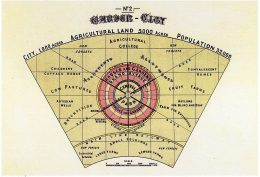
In other words, people captivated by what David Brooks has called the “Paradise Spell” will continue to seek freedom and fortune in the American West.  The result may not be your granddaddy’s sprawl, however.   We’re beginning to see planning for exurban development that is much more environmentally conscious and water-wise.  The project at Sterling Ranch located southwest of Denver is foremost among them. The plan for Sterling Ranch is akin to what Ebenezer Howard described as a Garden City.   It’s nearly identical in size (around 30,000 people) and broadly similar in form.  A dense, mixed use town center will softly transect outward into tightly knit villages and end in rural, hillside ranchettes.


Howard’s Model of the Garden City

Sustainability is the explicit design principle at Sterling Ranch.  The development will employ pioneering  water conservation measures, including rainwater harvesting (as per Colorado HB 09-1129), to support its 12,000 housing units and 31,000 people.  The estimate of water use per household is approximately one third of that traditionally required by Douglas County (.22 acre feet per household per year compared to .75).  At present Sterling Ranch developers are partnering with Denver Botanic Gardens in a “Community Supporting Agriculture” test case for evaluating whether the community’s fresh produce needs can be met locally instead of bringing fruits and vegetables in by truck.  In keeping with New Urbanist commitments local landscape and history will be respected in the project’s development, and a range of housing types and prices will be available (35% of the house product will be priced below $200,000).  Promotional material for Sterling Ranch riffs on a New West theme:

The New West retains the rugged personality, and natural beauty of the Old West, but has evolved to suit the lifestyles of today’s Westerners. Sterling Ranch provides plenty of opportunities to ride, run and play in natural settings, along with the sense of community that was once necessary when neighbors survived by working together. At the same time, it offers conveniences of modern life and a community that reflects today’s society and real-world conditions.  From a comprehensive water plan that ensures enough water for all; housing options that meet the needs of today’s buyers; public spaces that bring communities together; schools that teach skills the next generation needs to succeed; and Community Supporting Agriculture that grows food for our tables–Sterling Ranch creates a vision for the New West.

Sterling Ranch Conceptual Drawing

Sterling Ranch represents a noble vision and is an experiment worth monitoring.  Other Front Range developers certainly will be watching.  Assuming some success, the question will arise of  how many Sterling Ranch-style garden cities can the Front Range accommodate?  And, will this land use pattern promise any greater long-term environmental and social sustainability than, say, mid-to-high rise densification projects in the urban core, especially those that choose to experiment with vertical farming?

Front Range urban hydro-sustainability prospects are also complicated by the fact that water isn’t the only relevant variable affecting Western development. Peak Oil suggests, at least to some, that efforts to preserve our current way of occupying the landscape through technological innovation are doomed and that urban contraction is the only sustainable planning choice.   If there’s no significant energy savings associated with  transporting water horizontally to a population distributed in exurban Garden Cities as opposed to one that’s distributed in a high rise (Radiant City?) urban core, then contraction and vertical densification would seem to be the better bet.

There’s also the matter of Peak Population, especially as concerns ethnicity and age.  Sterling Ranch will undoubtedly attract a particular demographic that is white, middle-class, and nuclear family-based—and that’s OK.  But Colorado is clearly becoming increasingly diverse in terms of ethnic makeup.  As recently reported by North Forty News, Colorado’s Hispanic population increased by 41% over the past decade.  The African-American population rose by 19%.  The Asian population is up 45%.  In contrast, the white non-Hispanic population grew by 10%.  These increases occurred throughout the state and not just in metropolitan areas.  Will domestic minorities be drawn to communities like Sterling Ranch, or any other urban development, if cultural diversity is not a central planning and design concern?

We’re seeing the aging of Colorado’s population as well. The number of people over age 65 is predicted to increase 78% over the next 15 years, with the proportion of the total population moving from 9.8% to 17.4 %.  According to a survey by the National Association of Realtors that was reported in a recent New York Times op-ed, this aging “Boomer” population (born between 1946 and 1964) favors walkable urban downtowns, suburban town centers, and small towns.  Interestingly, the Times piece reports that the coming-of-age “Millennial” population (born between 1979 and 1996) appears to be favoring (by about one-third, according to various estimates) precisely the same kinds of settings for lifestyle reasons and for the convenience of not having to own cars.  These data suggest that we’re witnessing a major structural and demographic event: “the convergence of the two largest generations in American history” in preferring walkable, mixed-use, and centrally-located neighborhoods.

Thus, Peak Oil and Peak Population, insofar as Colorado is concerned, may be recommending a future that is traditionally urban and Old European, rather than exurban and “New Western.” It remains to be seen whether Peak Water is pointing in the same direction.  If it is, then urban planners and architects are facing a significant planning and design challenge for a Peak Planet age: how to make a time-honored, traditional form of settlement much more environmentally and interculturally attractive and sustainable.

Researching Urban Hydro-Sustainability

Posted by Dean Saitta on July 04, 2011
Sustainability, Water and The City / No Comments

I’m fortunate to be part of a transdisciplinary research collaborative that’s just received a $10,000 Institute for Enterprise Ethics grant from the University of Denver’s Daniels College of Business for a project entitled “Front Range Urbanism and Hydro-Sustainability.”  It has long been recognized that the key variable affecting the quality of Colorado Front Range urban life and growth is water. Accordingly, any city-building enterprise in the region must be informed by a sustainability ethic that centers on water.   Our research topic is the water conservation values, policies, strategies and technologies that have been identified by Front Range planners and developers as important for guiding urban growth in the region. We will evaluate the efficacy of current and recommended water utilization policies and practices for supporting sustainable urbanism along the Front Range.

Colorado Front Range near Louisville, north of Denver

The proposal was stimulated by a series of investigative reports, op-ed pieces, and reader letters that appeared in The Denver Post debating the recently approved development of Sterling Ranch, a community planned for the Chatfield Basin south of Denver.   Organized as a clustered arrangement of 7 “urban villages”, Sterling Ranch would contain over 12,000 homes and 31,000 people over a 20+ year horizon.  It is estimated that the project will generate over 9,000 permanent jobs.  Although promoted as a model of high density development having a progressive and praiseworthy water conservation plan, Sterling Ranch has nonetheless raised serious questions about where such planned communities will get their water and whether their water usage will be sustainable over the long haul.

Our research will seek specific answers to these and other questions about the hydro-sustainability of planned community developments along the Front Range.   The framing questions of the research include:

  • How much reliable water is available to planned suburban and exurban development? What are its sources?
  • What projections exist for required housing stock and non-residential construction over the next 5-10 years?  One high growth area in Colorado Springs is expected to be military housing. What other high growth areas are predicted for Front Range cities?
  • How likely is it that current and projected construction can be supported given the water that’s available?
  • What water conservation and storage methods hold out the most promise for sustaining urban growth into the future?
  • How might cultural variables complicate planning for Front Range suburban and exurban water use?

We will use our findings about current and projected water capacities and utilization, and our evaluation of proposed water conservation values, methods and techniques, to identify constraints on Front Range urban and suburban growth and project the future of urban hydro-sustainability in the area.  Will seek to publish our findings and recommendations in the Journal of Real Estate Sustainability.