Urban Studies

If a City Existed in Ancient America Would Historians Notice?

Posted by Dean Saitta on May 11, 2013
General, Urban Studies / No Comments

Apparently not, according to Michael E. Smith in a review of the new Oxford Handbook of Cities in World History over at his blog Wide Urban World.  Smith argues—rightfully—that cities developed in many areas of Central and South America well before the time of the European conquest. And, that these indigenous urbanisms were substantial enough in their form, geographical reach, and cultural impact to warrant chapter-length treatment in any comprehensive compendium of cities in world history (if we understand “history” to include the entire time period of human existence on the planet and not just time periods for which we have written records). Yet, they go largely unrecognized and unappreciated by urban historians.

Screen shot 2013-05-11 at 11.18.23 AM

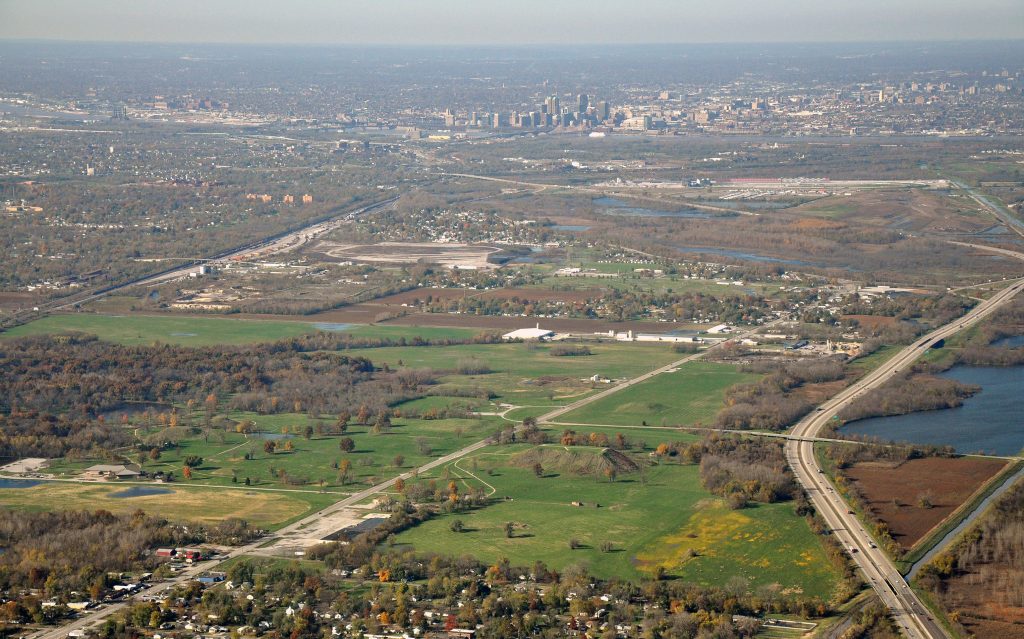
Monks Mound, Cahokia

An argument like Smith’s can also be made for North America. If Mesoamerica is Mars to urban historians then North America is Neptune—a place that lies even further beyond the orbit of world urbanism. As previously discussed on this blog (as well as by Smith himself), North America has good examples of both near-urban and fully-urban phenomena.  The ancient city of Cahokia (dating roughly AD 1100-1200) in the Mississippi Valley got some run recently in the pages of Science magazine with a consequent mention in Atlantic Cities.  This sprawling metropolis of huge earthen mounds and clearly differentiated public space attracted tens of thousands of people and created an impact felt hundreds of kilometers away.  The Mesoamerican archaeologist John Clark is quoted in the Science article as saying that if you found Cahokia in the Mayan lowlands its urban status would not be in doubt; indeed, “it would be a top 10 of all Mesoamerican cities.”  And, as reported in a Science sidebar, even earlier mound building cultures of the  lower Mississippi Valley may have had a role in actually shaping the origins and development of the great Central American civilizations described by Smith.

In short, for Smith urban history

…covers the entire world, through time from the earliest cities to the present. If we really want to comprehend cities and urbanism, a broad perspective is essential. Archaeologists have long appreciated the value of an inclusive comparative framework, and scholars of contemporary urbanization are starting to look to ancient and pre-modern cities as a source of ideas to better understand cities and their problems today and in the future.

This goes for me too, and probably John Clark as well. Smith suggests that scholars of “world history” are not yet clued into what we can learn about urbanism from the cities of ancient America.  They’d be well-advised to get a clue if they’re interested in better understanding the city’s role in imperial expansion, its virtues as a socially integrating and culturally creative force, and its limitations as a sustainable form of human settlement.

Is Anything Learned From the Kotkin-Florida Throw Down?

Posted by Dean Saitta on April 21, 2013
Intercultural City, New Urbanism, Placemaking, Urban Studies / No Comments
florida-kotkin-325x294

Richard Florida and Joel Kotkin

Now that the dust has apparently settled from the exchange in The Daily Beast (Kotkin’s opening salvo is here and Florida’s response is here) it’s useful to ask what’s been learned.  I think the short answer is “not much.”  These sorts of confrontations usually generate more heat than light.  Both authors have passionate critics and loyal defenders.  Robert Steuteville at Better! Cities & Towns rushed to Florida’s defense before the ink on Kotkin’s essay was dry:

Do educated professionals contribute to the economy, to the tax base, to jobs, to the educational system? If the answer is yes, then an influx of the “creative class” does indeed help the entire city and offer some benefit, directly or indirectly, to most of the citizens.  How about the amenities that attract the creative class? Are they worth investing in and do they benefit a broad swath of the public? These amenities include: walkability, transit, culture, quality public spaces, historical architecture, high-end jobs, education, connection to nature, and housing in walkable neighborhoods. The answer, again, is yes, yes, yes.

On the other side, Jamaal Green at Sustainable Cities Collective wasn’t going to dignify the exchange by commenting on it.  But he couldn’t resist a piece in Rustwire suggesting that the attacks on Florida are “overblown and insidious.”  Here’s Green on the “amenities” question and Rustwire’s claim that the interests of the poor and of the “gentrifiers” are aligned more than one might think:

Frankly, this argument is pure neoliberal, trickle-down economics. Thirty years of local, state and federal policies that have favored the interests of economic and political elites have shown us that simply assuming that the success of an elite group will help non-elites is wrong. Amenity-based development, “placemaking” projects, the varied accoutrements of the sustainable city like farmers markets and bike infrastructure, the intense redevelopment of central cities, the conversion of industrial land, and any other array of city or regional policy decisions and priorities are NOT value neutral or apolitical and have a disparate impact on city populations… The way many of these policies have been rolled out in American cities have seeded and exacerbated displacement, gentrification, housing affordability crises, and increased income inequality. To say that the interests of “creatives” and the poor or communities of color are one and the same implies an overlap that in many cities simply does not exist. There are legitimate trade-off decisions and real winners and losers when it comes to policy and planning decisions and we should honestly interrogate the disparate impacts of amenity-based planning strategies instead of effacing the real conflicts and decisions that undergird creative class policy.

WelcomeCreative.800

A few other quotes from Kotkin’s and Florida’s interlocutors at The Daily Beast capture a bit more of the third party mood and suggest that patience for both men is wearing thin:

 “Jasperinboston” goes after Kotkin thusly:

It seems to me Kotkin…has of late become something of a shrill, reverse parody of Florida….Maybe the latter’s claims about the creative class are sometimes exaggerated.  But Kotkin writes as if we’ve seen ZERO improvement in the position of America’s cities…Kotkin seems to blend his often insightful observations with large-ish dollops of hippie-punching and resentment, and an overemphasis on the hipster phenomenon. But not everybody who trades in suburban living for life in an urban core does so in order to party with long-sideburned PBR drinkers. Clearly the amenities and lower crime available in many of today’s cities are highly appealing. And then there’s simply the shorter commutes for those lucky enough to walk to work… I mean, for all the growth in jobs found in suburban office parks, the urban cores of America’s cities are still home to vast numbers of  (often very high-paying) jobs in areas like banking/finance, business services, government, publishing, architecture/design, academia, medicine/medical research, tourism hospitality, etc. Simply living near one’s job is, again, appealing to many people. Also, by all accounts much of the boom in urban living is driven by empty nesters — so it’s not just young, in-their-prime knowledge workers who are driving the phenomenon. Anyway, at the end of the day perception drives reality, and indeed becomes reality. And increasingly for better or worse the perception influencing the decisions of consumers, businesses and elected officials is that city life is desirable, and advantageous. I think Kotkin’s fighting a losing battle.

Williamsburg, Brooklyn

Williamsburg, Brooklyn: Forbes Best Hipster Neighborhood #3

“QueensArt” offers this about Florida:

New York, especially creative class poster child Brooklyn, is hemorrhaging economic and racial diversity. The fact is that regardless of professed political beliefs, the effect of the so-called creative class is to make a place whiter and richer. It’s gentrification with city resources accelerating the exile of whole segments of its citizens, in favor of attracting upper class settlers. Without cities enacting policies that balance the needs of the wealthy with the working and middle classes, creative class policies are nothing more than an act of contempt of a city against its own people. In the end, this will historically be viewed as destructive on the same level as red-lining and Robert Moses.

Michael E. Smith goes after both of them and suggests that maybe these aren’t the guys we should be listening to:

It is interesting that Richard Florida chooses to counter Joel Kotkin by personal attacks and critiques of things that were not part of Kotkin’s article. And he ignores the critiques of his creative class theory by urban scholars (e.g. Jamie Peck) cited by Kotkin. On the other hand, Kotkin ignores many aspects of Florida’s argument. But then these two are cultural entrepreneurs and not scholars, and they make their points in popular books and internet journalism, not peer-reviewed scholarly papers. I’d be more interested to hear what Edward Glaeser and other scholars of contemporary urbanism have to say about the views of both writers.

LoHi Denver: Forbes Top Hipster Neighborhood #17

LoHi Denver: Forbes Best Hipster Neighborhood #17

 “Barabbas” is even more pointed:

Joel Kotkin and Richard Florida are both irrelevant. Kotkin’s little fetish for suburban sprawl and nuclear families is an obviously failed experiment if households have to commute. It’s amazing that Kotkin can’t figure that out while he resides in the North Hollywood area. But cities are also a relic of the industrial past. Whatever economy of scale can be achieved with urban density is quickly erased by housing scarcity issues. Why do cities need to cluster population anyway?…The effects of the digital revolution are unclear beyond the fact that it has rendered many traditional occupations obsolete as well as the necessity of clustering population in cities.  It would be more interesting, though less profitable, to prophecy the emergence of resource-based organic communities throughout these magnificent United States of America. We have the technology and we have the indomitable spirit of the American people. The genius of America is the cultivation of genius. Kotkin and Florida are shills. The painful residue of the intellectual class rendered irrelevant by technological innovation. The demise of capitalism from within, exactly as Schumpeter predicted…

These, as well as the many dozens of snarkier comments on both sides, suggest that there’s little more to this “debate” than entertainment value.  At the end of his essay—and perhaps to his credit—Florida seeks to re-direct the conversation:

Enough already with this tired and divisive debate about families versus hipsters, cities versus suburbs. We know that cities and skills power growth and we know that we’re facing real divides and real inequalities. Let’s get on with the critical task of drafting the new social compact that our urban age requires. Now that’s a debate worth having.

Agreed. Florida’s proposed new social or creative compact is wide-ranging and has its virtues.  But other urbanists whose work I’ve highlighted on this blog—Jamaal Green, Richey Piiparinen, Neeraj Mehta—are doing much more to advance the placemaking conversation.  Aaron Renn and Susie Cagle ain’t bad either.  Theirs are the voices most worth listening to.

A Meditation on Universities, Interdisciplinary Teaching, and Sustainability Studies

Posted by Dean Saitta on March 03, 2013
Sustainability, Urban Studies / 1 Comment

Like many institutions of higher learning, the University of Denver is committing resources to greening our campus and encouraging teaching and research on sustainability. We have a Sustainability Council, a Sustainability Minor, and a nascent Center for Sustainability. Because of my interest in urban sustainability—and to mark the 100th post of this humble blog—I thought I’d reflect a bit on what’s happening on my campus and where we’re going.

1 green_banner.640

The catalyst for this essay was a recent panel discussion about sustainability initiatives on campus. Sponsored by the Sustainability Council, the event kicked off a series of cross-curricular dialogues about sustainability-focused teaching and research at DU. The panelists were from a variety of traditional academic units and professional schools (e.g., Law, Social Work, and International Studies).  The goal was to encourage discussion across disciplines and identify cross-cutting themes for future events, given sustainability’s inherently interdisciplinary character.

The event was both inspiring and depressing. Inspiring, because of the good work on sustainability that’s taking place within the academic units (e.g., on human-animal connections, business ethics and sustainability, global health). Depressing, because a common note struck by speakers and audience members alike is how hard it is to do substantive interdisciplinary team-teaching (i.e., something more than the typical dog-and-pony show) about any topic across academic units at DU.  Indeed, this was the main takeaway message of the event. The obstacles are structural, relating to the demands that individual units make on their faculty but also—perhaps more importantly—to the system for crediting team-teaching across units. Several participants noted that faculty with interdisciplinary teaching interests have to work in the “interstices” of what, at DU, is a very traditional academic structure.  This certainly can produce some good results, as the panelists demonstrated.  But a scattershot approach is no substitute for a broader institutional commitment that would better value this work and perhaps make DU more competitive in attracting top-flight faculty and students having interests in sustainability.

Academic territoriality is another serious obstacle.  Several years ago my colleagues within the arts, humanities and social sciences sought to create an Environmental Studies program.  They had a fully-justified proposal, courses ready and waiting, and participation pledges from faculty in a critical mass of departments. But the proposal was squashed because academic deans feared competition that would draw off students from the already established Environmental Sciences program. We’re trying again this year to get something going in the area of Environmental Humanities or Eco-Humanities.  However, the ancient survival impulse to claim and protect turf is apparently still alive and well on campus.  Last year DU’s Department of Geography received approval to change its name to the Department of Geography and The Environment.  It’s not clear how this was accomplished; it could be that all it took was submission of a self-interested request to the university’s Board of Trustees, a governing body that’s un-populated by professional scholars. At any rate, this is astonishing stuff because I thought we were beyond seeing the “The Environment” as an object of study to be owned by particular academic departments and divisions.  It also runs counter to the widespread recognition that sustainability—as something that’s intimately wrapped up with “The Environment”—is an inherently interdisciplinary concept. Anthropologists sometimes get territorial about the study of “Culture”, but I think we’re smart enough to realize that “Culture” is a complex phenomenon on which multiple disciplines can shed bright light.  “The Environment” is similarly complex, beginning with the fact that it is cognized and used differently depending on cultural context and history.  Any comprehensive understanding of human-environment relationships and, certainly, any effort to specify sustainable “best practices” for managing human-environment relationships requires exposure to theories and methods that span the natural sciences, social sciences, arts, and humanities.

2 Phoenix.landsat.800

Phoenix: A Model of Unsustainable Urbanism?

Promotion and tenure criteria can also impede the development of interdisciplinary teaching and research. Like many  institutions, a “star” mentality rules at DU, with the single-authored monograph and peer-reviewed journal article serving as coin of the realm.  The quest for star status can produce a certain insularity.  Over the last 25 years I’ve seen some very fine collaborative scholars and scientists leave the university because they ran afoul of the star system for evaluating faculty talent (for a particularly egregious case, see here). Others have left because of academic climate issues, like the particularly talented ecologist who, at a York University (Toronto) workshop on comparative urbanism in 2008, riveted a roomful of participants with a discourse on the importance of wildlife corridors to sustainable urban environments.  Stories like these relate to the challenge of building a faculty for 21st century interdisciplinary work on sustainability.  I’m not convinced that my institution knows how to meet that challenge, nor thought very much about it. Having star academics (whatever that means) in the fold is important, but so too is having the team-players who, because of their presence, make the whole much greater than the sum of its parts.  And it seems that holism and balance in all areas of academic life is what any institution looking to gain street cred in the area of sustainability should be aspiring to achieve.

Even the structure of the curriculum itself can hamper efforts to teach about sustainability.  One place in DU’s curriculum where team-teaching about sustainability might flourish is our Common (General Education) Curriculum.  The “Advanced Seminar” piece of that curriculum invites interdisciplinary and experimental courses.   However, the established requirement for these upper-level courses is that they be writing intensive.  This can work against courses with sustainability themes that might be better taught with pedagogies that are field or lab intensive like, say, a course on urban permaculture.

4 SLC.landsat640

Salt Lake City: The Next Big Thing for Modeling Sustainable Urbanism?

The parting shot to the Sustainability Council’s panel  discussion was a comment from one participant who declared that DU is positioned to do some “amazing stuff” in the area of sustainability.  I completely agree, but I don’t see how we can do this stuff without some financial and academic restructuring.  How hard can it be to produce a budgetary and credit-allocation model that actively supports interdisciplinary team-teaching across the traditional units and the professional schools?  Or, to structure a curriculum that allows pedagogy—whether writing-intensive, field-intensive, lab-intensive, performance-intensive, or some other intensive—to follow subject matter and course goals rather than being stipulated a priori?  Or, to combine programs with sustainability emphases—environmental science, eco-humanities, urban studies–under a single comprehensive umbrella?  We don’t have to go so far as to create a separate School of Sustainability Studies like they have at Arizona State University, although the ASU model of academic structure is producing some really interesting teaching, research, and public outreach initiatives. Something along the lines of the University of Utah’s program in Environmental and Sustainability Studies would do.  This program brings together scientific, humanistic, historical, and cross-cultural approaches to understanding the human-nature relationship. However, it’s not clear whether the University of Utah is doing better than any other institution in supporting interdisciplinary team-teaching or building a faculty for 21st century work on sustainability.

3 Denver_Colorado.aerial

Denver: A Natural Laboratory for Evaluating Models of Sustainable Urbanism

It’s probably not a coincidence that western cities provide the geographical setting for this progressive sustainability work.  Phoenix is a favorite poster child for unsustainable urbanism.  But that makes it an exquisite natural laboratory for thinking about, and testing, ideas about how to do things differently.  Salt Lake City is currently poised to get some run as a model of urban sustainability given that the Congress for the New Urbanism meets there later this year.  If some CNU leaders have their way, we could soon be talking up the 21st century relevance of 19th century Mormon town planning.  Denver has accumulated plenty of credibility as a place to watch for trying out different approaches to creating sustainable urbanism.  It‘s a shame that Denver’s university is not leveraging our faculty talent and unique location to create the amazing program in sustainability studies that, given a little structural and paradigmatic change, lies well within our reach.

Placemaking Resolutions for 2013: Lifestyle or Life?

Posted by Dean Saitta on January 27, 2013
Intercultural City, New Urbanism, Placemaking, Urban Studies / 1 Comment

My title is inspired by an excellent New Year’s Eve 2012 piece posted on New Geography by Richey Piiparinen (also posted here) that questions the “livability” focus of much urban development over the last few years. More about that below. First, here are the highlights of some other turn-of-the-calendar reflections and recommendations from leading urbanists:

Brent Toderian at Planetizen calls for more “holistic” thinking about placemaking, and urges rejection of the false choices presented by those who counterpoise, for example, smart growth and historic preservation, or beautiful and affordable design.  Most importantly, he urges that placemakers pay more attention in the coming year to population diversity and the issue of homelessness.

Cristiana Strava at Polis emphasizes sustainability as the key to better city living, including investment in public transport and community gardens.

The Black Urbanist urges that we spend some time thinking about how to best maintain places that are already great, like old homes, markets, and recreation centers.

Fred Kent at the Project for Public Spaces urges that we make 2013 the “Year of the Zealous Nut”: a new breed of engaged citizen who is passionate about their community.  He recommends an agenda that (1) re-centers transportation so that it helps to builds communities, (2) strengthens local economies through dynamic public markets, (3) builds neighborhoods with centers that are true multi-use destinations, and (4) advocates for a new architecture of place.

The Placemakers at Placeshakers and Newsmakers suggest that in 2013 communities will be best served by Tactical Urbanism. They urge an incremental approach to  development and the development of better methods and tools for measuring livability.

Mike Lydon, another blogger at Planetizen, is also keen on Tactical Urbanism (he’s one of the movement’s leaders), identifying it as the best trend of 2012 and something to push for in 2013. He channels Memphis Mayor A.C. Wharton’s philosophy of placemaking:

“Too often, cities only look to big-budget projects to revitalize a neighborhood. There are simply not enough of those projects to go around. We want to encourage small, low-risk, community-driven improvements all across our city that can add up to larger, long-term change.”

Finally, the various folks who write at Atlantic Cities take a slightly different tack by identifying urban trends that they hope will die in 2013. I’m mostly struck by Sommer Mathis’s suggestion that the term “pop-up” be abandoned as a descriptor of tactical urbanist interventions. She suggests that the term produces too many lame experiments and, more importantly, communicates a certain triviality of purpose that can conspire against efforts to turn “short term action into long term change.”

Living Walls, Atlanta

Living Walls, Atlanta (Sten Lex)

Looking at this variety of recommendations it’s clear that tactical urbanism is one of the urbanisms that enjoys great popularity at the moment.  And that’s why of all the end-of-year stuff I read I like Richey Piiparinen’s piece the best.  First, anyone who references David Harvey immediately gets my attention, in this case Harvey’s observation (contained here) that– in the ongoing competition to gain status as desirable (i.e., livable) cultural and consumer centers– cities must

“…keep ahead of the game [by] engendering leap-frogging innovations in life styles, cultural forms, products and service mixes…if they are to survive.”

Tactical Urbanism’s pop-up parks, cafes, galleries, gardens, and street art are an important set of strategic attention-getters.  I’m actually sympathetic to the idea that such tactics can be as important as investments in housing and transportation in improving livability or what others call “vibrancy.”   Carol Coletta, director of ArtPlace, eloquently frames the idea in the following way:

“I think you can do temporality with regularity. Some temporary events are so powerful that they stay in the memory for a long time, and spark the imagination.”

And where imagination is sparked, permanent changes that enhance livability and vibrancy can follow.  But Piiparinen usefully asks “Livability” for whom?  And at what cost?  Too often the focus is not on a cross-section of the urban demographic but rather on a select group of folks; namely, the “creative class” of high-valued consumers with disposable income.  Consequently, current urban interventions—tactical or otherwise—too often reproduce the divide between amenity-rich and amenity-poor neighborhoods.  And at the end of the day they might not do much to give a city (or the neighborhoods within it) an edge in creative class competition. Harvey notes:

“Many of the innovations and investments designed to make particular cities more attractive as cultural and consumer centres have quickly been imitated elsewhere, thus rendering any competitive advantage within a system of cities ephemeral… Success is often short-lived or rendered moot by parallel or alternative innovations arising elsewhere.”

Rio de Janiero

“Paraisópolis”, São Paulo

The constant search for new “sensory and savory experiences” amounts, for Piiparinen, to a “Willy Wonka Urbanism” that’s serves the pleasure of a relative few and signals what Harvey calls “the triumph of image over substance.” Playing off of Harvey, Piiparinen suggests that

“…there are problems with such city building: it’s too often defined by the ephemera, or that “transitory matter not intended to be retained or preserved”… The ephemera aren’t building blocks to economic growth, but instead represent America’s tendency to fix hard structural deficits with the airy promises of the pleasure principle…I would argue that now more than ever we need less fantasy in city building than we do reality…”

Stop the Violence, Chicago

Stop the Violence, Chicago (Metropolis Coffee)

Piiparinen’s reality is about “affordable housing, mobility, education, and jobs.”  His analysis converges with that of others whose ideas we’ve highlighted on this blog. Neeraj Mehta similarly questions who creative placemaking is for, an account that we previously discussed here.  This question certainly informs just about all of the posts  in my continuing commentary on an important and controversial infill development in Denver. Piiparinen’s recommendation for urbanism in 2013 is certainly compatible with those of other resolution-makers, especially Toderian on demographic diversity.  His parting shot hits the nail on the head:

“…perhaps it’s time for city leaders and citizens alike to take stock in how cities are being made, and for whom the making is focused. In fact maybe it’s time to drop the “livability” gimmicks that define Willy Wonka urbanism–or to squeeze “the style” out of “lifestyle” so as to expose the highest priority, the highest necessity: which is life.”

The Towers of London

Posted by Dean Saitta on January 04, 2013
Architecture, Intercultural City, London, Urban Studies / No Comments

LONDON 4 January 2013.   London is currently experiencing a relative frenzy of high rise building. The existing and proposed structures are known locally by their shapes, including “The Shard,” “The Cheesegrater,” and “The Walkie-Talkie” (or—better in my view—“The Pint”).  Just over a month ago The Observer’s architecture critic Rowan Moore examined this building trend.  He posed a series of excellent questions that should be asked of all towers proposed for any city on earth:

Do they… show consideration of scale or proportion or try to make a meaningful relationship with their surroundings? Is there anything special about their detail? Is there consistency or integrity in their overall concept? Do they create handsome new public spaces at their base? Does their internal planning produce the best possible living or working spaces, which are well laid out and make good use of daylight?   Failing all the above, do they have any worth in the rapidly debasing currency of iconicity? Are they, in other words, exhilarating to contemplate or innovative—do they transmit some sort of buzzy excitement about London being a dynamic world city?

Credit: Nick Brown

“Is London’s Skyline Going Down the Tube?” (Credit: Nick Brown)

Regrettably, Moore has to answer “no” to all of these questions when they’re asked of the Towers of London. He argues that most of the two dozen or so towers currently being built in the city are of poor architectural quality.  They’re located in places that don’t make sense, where they either interfere with the “long views” of historic sites, or they’re not well served by public transport.  They don’t create appealing and accessible public spaces, either at their bases or in the form of viewing galleries on their upper floors. Perhaps most importantly, they’re non-compliant with master planning principles or are being built over the objections of local neighbors and statutory authorities.

The Shard, Viewed from near St. Paul's Cathedral (D. Saitta)

The Shard, Viewed from near St. Paul’s Cathedral (D. Saitta)

Mr. Moore is not an anti-tower Luddite. He notes that towers can be beautiful, and that a good part of London’s genius over the last 2000 years has been its ability to accommodate changing architectural styles.  But for Moore today’s towers are “mostly units of speculation stacked high, garnished with developers’ ego…There is no vision, concept or thought as to what their total effect might be on London, except that it will be great.”

The Cheesegrater (D. Saitta)

The Cheesegrater, 122 Leadenhall Street (D. Saitta)

I was impressed by the number of reader comments on Moore’s piece—404 submitted over the course of two days. These surely cover the waterfront of popular opinion about high rise building in London.  It’s a very close call as to which position wins out: pro-tower or anti-tower. Many readers agree with Moore that London’s Towers are another form of urban blight. This comment, from “redshrink,” is typical:

Their gimmicky shapes and their scale conceal a dull sameness at their core. Their apparent variety is only a thin veneer on the model of a streamlined, corporate city that ends up looking like any other of a similar mold—like Shanghai or Dubai.

Pint7.800

The Pint, 20 Fenchurch Street  (D. Saitta)

Tower haters often propose more aggressive central oversight and planning to keep greedy developers in check and prevent the London skyline from being completely destroyed. Other readers suggest that London’s skyline can’t be destroyed because it never really had one, although admirers of Christopher Wren’s churches and Canaletto’s representations of them would surely disagree. One reader suggested that the absence of skyline is falsified by anyone who’s been to Parliament Hill, or even to Primrose Hill.  Those who see the towers as enhancing the skyline suggest that a city has to change with the times. As Moore notes, this adaptability is a big part of London’s distinctiveness and appeal. London is not a set museum piece like Paris, whose well-preserved urban core is beautiful but also borne of autocracy rather than liberty.

Canaletto1.800

London Skyline by Canaletto, 1747

The most thought-provoking reader comments introduced a more nuanced and complicated calculus for evaluating the pros and cons of tall buildings.  One reader (David Kane) suggests that London towers must be evaluated in light of the city’s differentia specifica as an urban phenomenon:

I agree with the comment that Paris has been well served by town planning, as have many other cities. However, it’s a little late to impose top-town town planning on London. It has never been such a city. London is a series of villages that have, over time, become part of London. London’s intrigue is in its infinite variety, not its beautiful cityscape.  I like The Shard, because I like the mix of old and new, but I confess, I’m not convinced by all the new buildings going up and some of them may look out of place. None-the-less I prefer to see London in a state of flux, adapting to the needs and demands of its people.

Another reader (“280E”) plays off of Moore’s reminder of London planning officer Peter Rees’ belief—apparently ignored in practice—that towers work best when clustered together:

By avoiding the creation of a concentration of tall buildings (so far anyway), the problem of architectural quality is exacerbated, since every building needs to carry the full responsibility of the skyline by itself. If you look at cities famous for their skylines, such as NY or Chicago, most of the buildings are actually quite uninteresting individually (particularly in NY’s case), but they add up to a great overall effect, and can be very engaging at street level.

Canaletto2.800

London Skyline Today (Reuters)

A third reader (“Petengeth”) likewise suggests that towers are best appreciated not on their own but rather in relationship to something else, specifically the older buildings with which they coexist. Such coexistence doesn’t have to be uneasy. In fact the modern and the ancient can bring out the best in each other:

I don’t live in London, but visit occasionally. One of my favourite things is that contrast between shiny glass towers and tiny ancient pubs squeezed in in little gaps, like reminders of the past. Something London does really well.  Save the best and build the best, that is the answer.

SwanTavern.800

The Swan Tavern, 77-80 Gracechurch Street (D. Saitta)

The “best” towers, then, are (1) conscious of their historical context, (2) cluster together and make collective meaning with their fellow travelers, and (3) invite contrasts (or comparison) to what has come before.  By this accounting London’s towers do pretty well (but for a different assessment, see here).  The Cheesegrater does slope in order to accommodate the view of St Paul’s Cathedral from Fleet Street (regrettably, The Shard ruins the view of St. Paul’s from Hampstead Heath).  The Pint does symbolize something widely associated with British culture, the building’s accumulationist logic (i.e., its more valuable upper-floor bulge) notwithstanding.  And as many others have observed, The Shard does recall a Wren spire, especially when viewed from, say, Hackney.  But in another sense these buildings still suffer from a lack of intercultural resonance.  What would a 21st century tower look like that turns on an intercultural sensibility, rather than individual architectural conceit?

London Calling: Investigating Post-Olympics Regeneration in the East End

Posted by Dean Saitta on December 25, 2012
Intercultural City, London, Urban Studies / 1 Comment

An earlier post about London on this blog was inspired by that city’s August 2011 riots.  In reporting the results of Hackney borough research by my former student Kiley Dowling I wondered if the urban improvements promised by London’s “Regeneration Games” would produce a more equitable intercultural city or simply create gentrified enclaves in a much bigger sea of economic deprivation.  The last great East London regeneration project—Canary Wharf—did not improve local quality of life nor narrow the gap between rich and poor as much as some had hoped.  Doubts that the Olympics could do any better for the borough of Newham and its neighbors were expressed by critics at the time of London’s 2005 Olympic bid (e.g., here). Beginning later this week I’ll be able to judge for myself the current state of post-Games regeneration—the progress and the potential—during  a two-week research trip to the English capital.

Olympia 2012 in London

Olympic Park, with Canary Wharf in the Background (Spiegal Online)

London’s Olympic Games themselves have been hailed as a success by most reviewers.  But the jury is still out on whether improvements to the East End promised by the 2012 Olympics Legacy Plan will benefit long-time residents and newcomers alike.   Elements of the plan were contained in London’s 2005 Olympic bid, which is nicely contextualized in this scholarly article by John and Margaret Gold.  The bid promised sporting venues for citizens, public parkland, better quality housing, improved transportation facilities, and other infrastructural amenities. It also promised that the Games would be leveraged to celebrate the city’s ethnic diversity and create greater social inclusiveness.  According to Gold and Gold:

The bid strove hard to offer a rebranding of London away from being identified by its historic heritage to that of a diverse city with a vibrancy based on its multiculturalism. Much was made of London’s diverse ethnic identities and the multicultural character of the five ‘Olympic boroughs’ in the East End (Greenwich, Hackney, Newham, Tower Hamlets, Waltham Forest), where the main events would be housed.  The theme of the world coming to London to meet the world was  carefully fostered in marketing the notion of London 2012…

A London School of Economics (LSE) series on the 2012 Olympics is especially helpful in framing the East End’s regeneration challenge.  The cumulative message of the series so far is one of mixed blessings and open questions.  It notes that the Games were, in at least a few ways, a model of sustainability.  Wide pedestrian promenades and bridges linking Olympic venues will be retrofitted to human scale as the site is transformed into an urban park.  The park itself is a marvel that draws on English history and landscape design, celebrates native biodiversity, and incorporates absorbent flood control measures.  Several event structures will be shipped to other international sporting sites for reuse (e.g., the 2016 Rio de Janeiro Games), or will have their constituent parts recycled.  The remaining structures—like the Olympic Stadium and Aquatics Center—will be downsized for club football and public use.  Laura Mosca, writing in Metropolis Magazine, has a hard time squaring the concept of sustainability with the Olympic Games but she still admits that

London has introduced concepts of temporality in its buildings, unlike previous Olympic host cities. Most of the major sporting structures will decrease in size following the closing ceremonies, or transition into other programs and uses. For this, London should be applauded. They have stepped into the zone rarely taken by architects of impermanent place making.

London /

Designed for Sustainability: Olympic Stadium and Aquatics Center (Spiegal Online)

The extent to which local neighborhoods will benefit from other remaining infrastructure is another matter. Certainly, improved London Underground and Docklands Light Railway transportation services have better integrated the East End with the rest  of London.  Middle class people have been moving into the area and housing prices, at least in the boroughs surrounding Newham, have been increasing. But it’s a different story for long-time residents.  Olympic development has already displaced hundreds of people from their homes to places where rents are higher and neighborhood support networks are missing.  University College London’s bid for new satellite campus near the Olympic Park may doom the Carpenters Estate public housing complex and force additional displacement. There are questions about the availability and affordability of the 2,800 apartments that will be made public in the Olympic Village.  Economic times being what they are, there likely will be fewer affordable units than originally planned, and most of these will likely be priced beyond the means of Newham’s poorest residents. A new academy school planned for the site may draw the best and brightest students from surrounding areas and leave local kids on the outside looking in. Jobs for young people is another critical concern.  Olympic venue construction displaced 200 companies employing 5000 people. Most Olympic jobs didn’t go to local residents, and the post-Olympics job market remains thin. The LSE reports that the income gap between Newham and rest of London actually widened between 2006-2011.  Stratford is presently a tale of two economies: a new one exemplified by the upscale Westfield Shopping Centre and an old one rooted in the adjacent 1970s mall and its connecting, Starbucks-free High Street.

London 2012 - Vorbereitungen

Westfield Shopping Centre, Stratford (Spiegal Online)

One of the more recent essays in the LSE series by Don Flynn is interesting in that it returns to the ethnic diversity and social inclusiveness theme of the original London Olympics bid.   Success in fostering an intercultural and inclusive East End is imperative because London is an important symbol of truly cosmopolitan urbanism in British and other “national imaginaries.”  Flynn writes:

The legacy question is, how do we build on these weeks of showing the world what a global community in one city can look like? Will we find voices in other parts of the UK which are prepared to resist the doomsters who predict only disaster coming from internationalism, and who can map out perspectives for their cities and regions which are also about greater involvement in the wider world?  Most of all, will the leaderships of all the political parties in Britain rise to the challenge and stop talking about immigration as a mistake that should not have been allowed to happen? If the voices in Parliament and in Whitehall’s corridors of power prepared to speak out on this issue become more numerous and more confident in their arguments, then that might prove to be the very best legacy we can hope for from the London Games 2012.

To which the lone commentator on Flynn’s essay (“Sue”) pointedly responds:

What makes you think it’s the politicians that are discussing this? It’s us, the displaced, those who feel as though we are strangers in our own country that are openly talking about it. Many of us, ethnically cleansed and driven from our homes in East London and other cities where our families have lived and worked for generations. We are the ones that have been forgotten. Immigration is fine if it’s controlled. It has not and is still not being controlled. It’s a shambles and has brought England to it’s knees and alienated the indigenous population. So stick that in your leftie, progressive pipe and smoke it.

fuck-the-olympics1

Clearly, along with the many open questions about East End regeneration there are many open wounds and simmering hostilities.  Nonetheless, there’s evidence that multiculturalism in the UK can work, and that it works best when native Britons support it.  Popular support clearly depends on many things, especially a more equitable distribution of political and economic resources.  Several LSE observers note that the open and flexible framework of streets in the Olympic area, along with other infrastructure, create the potential for coherent placemaking that can be interculturally integrative.  There are examples from other cities that illustrate what both the process and product of intercultural urban planning looks like. In London, the word from master planners and participating architects is that the new developments will connect with the old–including the East End’s “scruffy fringes”–using the urban fabric that’s already there and eschewing demolition.  Ideally this will be accomplished without losing the organic messiness that’s long been part of East London’s attraction.  In short, East London’s primary challenge is the same one that exists elsewhere.  Innovative, inclusive placemaking requires a system of checks and balances (and compromises) to ensure that increasing land values and in-migration do not push existing communities out; i.e., that market forces and gentrification don’t trump public housing and urban renewal.  Certainly, political and budgetary courage is also a requirement. Intercultural (East) London is a lovely “imaginary,” but it will take time and effort—and perhaps some new ideas about how materiality and sociability work together to create place—to make it a reality.

Travel London 2012 Transformed

East London Street Corner (Spiegal Online)

Millennial Urbanology

Posted by Dean Saitta on December 03, 2012
General, Sustainability, Urban Studies / No Comments

Like the question about what constitutes good urban placemaking, the question about the lifestyle tastes and desires of the particular demographic that creative placemakers seek to attract—the Millennials—is a major preoccupation for urbanists.  Yesterday’s Denver Post, for example, contains an op-ed piece by Neal Peirce that notes the widely reported Millennial desire for “urban communities with active street life, entertainment, and stimulation.”  Peirce uses Jeff Speck’s recent book Walkable City as an entry point for arguing that the cities we need to create must be—you guessed it—walkable, bikable, green, and public transit-oriented (for a summary and review of Speck’s book, go here).

One of the advantages of teaching urban studies to a college audience is that we can take something of the pulse of what Millennials want in urban places.  In future posts I’ll report what I learned about Millennial tastes this past academic term from having my students analyze contemporary urbanism in Denver. Denver is one of the cities—along with New York, Boston, Chicago, San Francisco, Portland, and Minneapolis—that  Peirce says is making good progress toward creating active and sustainable urban environments (see also here).

The in-class preparation for urban fieldwork includes playing and discussing the BMW Guggenheim Lab’s Urbanology game, as well as discussing films like Gary Hustwit’s Urbanized [Note: Urbanized took us three class meetings to finish watching because of the animated discussion it stimulated. We kept coming back to its themes throughout the course of the term. I should write something up about this soon]. The Urbanology game asks players to make choices about urban issues, producing some quick findings based on the choices. The player assumes the role of a decision maker and answers questions to determine the priorities of his or her city. By answering “yes” or “no” to 10 questions like “Will you double the cost of public transport to fund its conversion to a carbon-neutral system?” or “Will you pay for a free bike service in your city?” players build a future city that best matches their indicated desires and needs. Then, the player is told what real city most closely approximates their values as an urban decision-maker.

In a previous post I discussed the results of Urbanology game-playing by my Fall 2011 class.  The top two values for that group of Millennials were Livability (investments in security, recreation, and individual comforts), mentioned by 41% of the students, and Health (investments in general physical well-being) mentioned by 26%.  Sustainability was the third most frequently mentioned value, by 22% of the students.  These results would seem to be consistent with Millennial tastes as defined by Pearce and others.  Perhaps predictably, these Millennial values differed from my own Baby Boomer values. In the twenty times I played the game Sustainability (investments in “greening” the city) was identified as the top value 30% of the time, with Lifestyle (investments in arts, sports, culture, and tourism) a close second at 25%.  At the time I explained this Student-Instructor difference by appealing to generational factors: at this point in my life I’m much more interested in the quality of the urban community that will be inherited by my middle school-aged son, and much less interested in the individual personal comforts and amenities we might reasonably expect to be of great interest to college-age Millennials. Curiously, however, Student and Instructor values produced the same list of real cities, albeit in a different rank order.  The top city for students was Berlin with 37% of the mentions, followed by Toronto with 33% and Shanghai with 26%.  My list was topped by Shanghai with 25% of the mentions, followed by Berlin and Toronto with 20% each.

Game-playing by my 2012 class of Millennials generated the same three cities, but in a slightly different order.  Berlin got 38% of the mentions, followed by Shanghai at 35% and Toronto a distant third at 23%. Interestingly, the urban values generating this list in 2012 were decidedly different from 2011.  In 2012 Sustainability was identified as the top value by 31% of the students, followed by Livability at 19% and Lifestyle by 15%.   I played the game another ten times and the results were consistent with the first time I played. Shanghai is still my top city with 30% of the mentions, with Sustainability and Lifestyle sharing top-spot value honors with mentions of 30% each. I’m not sure what to make of these numbers.  Minimally, they suggest that my values as an aging Boomer are understandably stable, while those of my young Millennial charges—also understandably—are a bit more in flux.  The latter might imply that we shouldn’t be too confident of our ability to predict what Millennials want in an urban setting.

For reasons discussed in my original post, results of the Urbanology game can leave you scratching your head.  They raise student (and Instructor) suspicions that the game is “rigged” in a way that guarantees certain results. Yet at the same time students really enjoy playing it.  One student comment on the anonymous end-of-term course evaluation captures, I think, the consensus of the class about Urbanology’s virtues:

The Urbanology game fit the class well. It was a useful tool and timed well as it was used early in the course, and was very fun and stimulating.

The game clearly puts students in touch with compelling urban questions and conundrums that they’ve never thought about before, as well as with their own personal values and politics.  They express a near unanimous desire to see the game developed in such a way as to add more complexity, context-sensitivity, and nuance (i.e., getting away from having to answer “yes/no” to difficult questions).   If nothing else the game is  a terrific conversation starter about the kinds of choices and compromises that have to be made in designing and developing a city.   More bankable insights about what Millennials want, however, come from putting  them into the field to study what urban planners and architects are actually doing with infill sites and public spaces like urban parks.  More on that to come.


Questioning Creative Placemaking

Posted by Dean Saitta on November 19, 2012
Intercultural City, New Urbanism, Placemaking, Urban Studies / No Comments

Placemaking talk is everywhere these days.  So too is “creative class” talk.  Richard Florida—formulator of the creative class concept—combines them in a recent essay for Urban Land.  Many people are on board with the notion that quality of place has something to do with urban vitality and creativity.  We aspire to urban settings that are appealing and animated, inspire innovation and risk-taking, and stimulate the economy by producing new businesses.

Complicating these discourses, however, is the undeniable fact that social and economic inequality is at record levels in the United States.  As Florida himself notes, American society is becoming increasingly class divided. Only about one third of American workers are employed in the creative class fields of science, technology, business, management, health care, law, arts, culture, design, media, and entertainment.  The other 66% are employed in personal care, retail sales, and food service.  Their ranks are expanding and, as Florida also notes, there’s a powerful racial dimension to this class division.

Creative Class Share of the Workforce (Bureau of Labor Statistics)

For cities, deepening social inequality is translating spatially as increasing residential segregation. As summarized by Emily Badger, a recent Pew Research Center Report on “The Rise of Residential Segregation by Income” found that

In 1980…85 percent of census tracts in America were either predominantly middle-class or mixed-income (this is a pretty impressive number). As of 2010, that figure had fallen to 76 percent. Today, considerably more upper-income Americans live in neighborhoods where the majority of their neighbors are upper-income, too (18 percent, up from 8 percent in 1980). And lower-income households are increasingly clustered in the same neighborhoods, as well (28 percent, up from 23 percent in 1980).

At the same time, the Pew Report notes (page 13) that

Looking at the trends from 1980 to 2010, it is also clear that residing in a majority upper-income tract has not reduced the exposure of its residents to neighbors who are lower income. In 1980, the average majority upper-income tract was made up of 7% lower-income households. By 2010, the typical majority upper-income tract had 10% lower-income households.

Thankfully we have observers like Neeraj Mehta, Research Director of the Center for Urban and Regional Affairs at the University of Minnesota, to remind us of what these social and spatial patterns mean for the placemaking enterprise.  Last month he had a nice post in Next City framing the key questions that all creative placemakers (and not just those who work their placemaking magic through the arts) should ask:

For whom are we trying to create benefit when implementing our creative placemaking strategies?… Which people do we want to gather, visit and live in vibrant places? Is it just some people? Is it already well-off people? It is traditionally excluded people? Is it poor people? New people? People of color?

“Hot tub parklets are dandy, but for whom are we building them?” (Mehta, Next American City. Image credit: Paul Krueger on Flickr)

Mehta suggests that creative placemaking should benefit not just cultural creatives but also low-income communities and communities of color.  Florida, in his Urban Land piece, implies that creative placemaking depends on accommodating these economic and ethnic differences:

Creative-minded people enjoy a mix of influences. They want to hear different kinds of music and try different kinds of food. They want to meet and socialize with people unlike themselves, to trade views and spar over issues. A person’s circle of closest friends might not resemble the Rainbow Coalition—in fact, it usually doesn’t—but creatives want the rainbow to be available.

But while Florida extols the virtues of “accessible diversity” as a means to stimulate creativity he says some things about the desired physical quality of creative places  that may not square with the goal of culturally-inclusive placemaking:

Authenticity—as in real buildings, real people, real history—is key. A place that’s full of chain stores, chain restaurants, and chain nightclubs is seen as inauthentic. Not only do those venues look pretty much the same everywhere, but they also offer the same experiences you could have anywhere.

It seems to me that “authenticity” can easily serve as code for the kinds of upscale restaurants, retail outlets, and other amenities enjoyed by white, middle-to-upper class culture. And, it can easily price people of color out of urban settings where their involvement is otherwise required if creativity is to be stimulated.  At the very least such establishments often manifest a set of visual symbols or “cues”—Mike Davis might use the term “archisemiotics”—that signal who’s welcome in a way that can work against social mixing.  The chances of encountering The Rainbow is undoubtedly higher in places that judiciously meld “authentic” creative class desires with the “value alternatives” required (if not altogether desired) by the majority urban underclass.

Experience says the creation of such hybrid settings—at least here in Denver—is not going to be easy. For example, the exercise in placemaking  at 9th and Colorado that we’re following on this blog has generated great local resistance to accommodating the sorts of value shopping alternatives that attract “The Other.”  This, despite the fact that ethnic and class diversity in the trade area is palpable.  Specifically, 16% of residents in the primary zip code in which the 9th and Colorado development is located are in poverty. This puts the area in the low to middlin’ range of urban poverty if we accept Pew Economic Mobility Project definitions of low poverty (less than 10% of the population live in deprivation) and high poverty (more than 30% of the population live in deprivation) neighborhoods.  The three Denver neighborhoods immediately adjacent to the 9th and Colorado site together contain around 10% lower income households, a number that’s consistent with what the Pew Residential Segregation Report (quoted above) considers typical for the nation as a whole.   Thus, better-heeled citizens in the re-development area have exposure to income (and ethnic) diversity but they’re still not keen to pay much placemaking attention to it (nor are their elected city councilpersons).  Interestingly, I’ve noticed that the most vocal local opponents to the kind of development that might attract social diversity are people who work in the arts and other creative class industries.  Thus, the “tolerance for strangers” that Bonnie Menes Kahn (referenced by Florida in his Urban Land piece) says is an important hallmark of cosmopolitan culture doesn’t seem particularly well-developed in this part of Denver.  Nor is it likely to be well-developed elsewhere in the city: Denver’s overall Residential Income Segregation Index (RISI) rose 21 points between 1980 and 2010, a rate of increase exceeded only by three cities in Texas:

Richard Florida has done great work to track the growing social and economic inequality of American society. Now, creative placemakers need to acknowledge the existential reality of the urban underclass when devising their schemes, and not simply that group’s potential to serve as a conceptual foil for the creative pleasure of cultural elites. By now it should also go without saying that all community stakeholders–including those representing the urban underclass–should have a place at the table when discussing placemaking alternatives. Neeraj Mehta nicely articulates the challenge:

We need to create an explicit pro-equity agenda to our creative placemaking efforts [and] be explicit about who benefits from the beginning… It’s really an issue that all of us working on ways to build stronger, healthier communities should be willing to ask, over and over again.

Imagining Aerotropolis

Posted by Dean Saitta on September 24, 2012
General, Sustainability, Urban Studies / No Comments

Franco Minganti

It was a pleasure to welcome Franco Minganti, Professor of American Literature at the University of  Bologna, to my campus last week. Franco is the European-side Co-Director of a European Commission/United States Department of Education curriculum development grant awarded to the Universities of Denver and Bologna, along with our co-partners Portland State University and the University of Nottingham.  The grant sponsors exchanges of faculty and students between the United States and Europe to study issues in global citizenship and urban sustainability. While visiting DU Franco participated in Italian language and literature classes, seminared with students in my Culture and The City course, and gave a public lecture to students and faculty.

DC-4 Passenger Plane Flying over Manhattan (1939)

Franco’s public lecture, titled “Icarus and Daedalus,” explored the relationship between flight, architectural design, and urban planning.  He explained the intimate relationship that was forged between flight and urban design in the period between the World Wars.  Flight in the inter-war period was framed as an urban experience.  Historical photographs from the period show how the city served as backdrop to, and a prop (no pun intended) for glorifying the activity of flying.  Images juxtaposing buildings and aircraft inspired architects and planners to go vertical, and fueled the 20th century’s “skyscraper ethos.”  Franco noted that the work of Le Corbusier was also instrumental in promoting verticality. Le Corbusier waxed poetic about how aerial photographs changed our perspective on the city and added a “third dimension” to architecture (M. Christine Boyer further develops this theme).  The photos also inspired him to contemplate the effects that humans have on nature and landscape. Franco thus reaffirmed the truth of Dan Solomon’s remarks at this year’s Congress for the New Urbanism (link to video is available here) that there are “many Le Corbusiers” other than the one we’ve come to know via the prescriptive Athens Charter or the sterile modernism of his many admirers and followers.

Skyscraper Airport for City of Tomorrow (Nicholas DeSantis, 1939)

In the Q&A following Franco’s lecture a colleague noted that today’s interest in aerotropolis as advocated by John Kasarda (including the serious interest being shown by politicians and developers here in Denver) mirrors the Inter-War period’s fascination with flight and urban planning.  But it also inverts the relationship between cities and flight in a potentially unhealthy way. In the 1930s the airport was premised on the city.  Airports were imagined to occupy the rooftops of buildings, as in Nicholas DeSantis’s famous 1939 drawing for Popular Science.  Today, the advocates of aerotropolis premise the city on the airport. As Michael Powell notes in his New York Times review of Kasarda’s book, aerotropolis not only contains a state-of-the-art airport but also:

…customized transportation links, fine restaurants, designer shopping, and nearby corporate suburbs connecting workers umbilically to the global marketplace. The aerotropolis…represents not just a redesign of travel but a vital new economic paradigm.

Model for Incheon International Airport Business District, South Korea, by Fentriss Architects (D. Saitta)

This vision of aerotropolis means that travelers never need to visit historic downtowns, nor experience firsthand (and in all their messiness) the local cultures and heritages that comprise the city as it really exists. Instead, travelers can experience sanitized versions of culture and heritage as simulacra within the aerotropolis.  Networked aerotropoli also promise “frictionless travel” akin to that supported by the high speed train systems already linking (or proposed to link) cities in Europe and elsewhere, usually over great public protest (Gary Hustwit’s film “Urbanized” features the controversy over Stuttgart 21, and when I was in Bologna last spring graffiti condemning Treno Alta Velocità was everywhere).  Frictionless travel can have not only steep social and environmental costs, but it can diminish the experience of travel in “inter-urban” areas that are bound to go through some interesting changes as the planet rapidly urbanizes.

Anti-TAV Graffiti, Piazza Giuseppe Verde, Bologna (D. Saitta)

Michael Powell notes that the aerotropolitan vision of a more frictionless future lacks “something like a soul.”  Wall Street Journal reviewer Wayne Curtis echoes this sentiment, describing the vision as  “dispiriting.”  Curtis goes on to suggest that Kasarda’s popular book:

…will no doubt do for airport cities what Joel Garreau and his “Edge City” did for suburban office parks and shopping malls two decades ago: It will re-locate the center.

Today, many of these relocated centers are not holding.  Some are being retrofitted.  In fact Edge City retrofitting could be the 21st century’s version of 1960s style “urban renewal,” meaning that we’ll end up wondering what we were thinking when we built this stuff in the first place.  Thus, advocates of aerotropolis in Denver and elsewhere should be careful what they wish for.

Archaeology and the Intercultural City

Posted by Dean Saitta on August 21, 2012
General, Intercultural City, Urban Studies / No Comments

As noted in a previous post, last June’s Venice Seminar continually prompted me to think about what the “deep time” perspectives of evolutionary psychology and archaeology can contribute to the conversation about intercultural place-making.  I’ve argued that Evolutionary Psychology might direct us to some cross-cultural common denominators of taste useful for shaping the form and aesthetics of the intercultural city.  This post looks at what the deep time perspective of Archaeology—a discipline  committed to exploring the range of variation in the way that people live across time and space—can contribute to the intercultural cities project.

The urban archaeologist Michael E. Smith, along with his colleagues in the School of Human Evolution and Social Change at Arizona State University, has already done a bunch of heavy lifting in this regard.  Michael’s scholarly publications emphasize the importance of taking a comparative perspective on the city as a way to better understand variation in urban form and the conditions and processes that produce urban prosperity, security, and resiliency.  His blog Wide Urban World broadcasts these concerns to a popular audience. Smith problematizes concepts like urban “sustainability” and considers whether sprawl, residential clustering, and other familiar characteristics of today’s cities are exclusively modern phenomena.  They aren’t.  Cities in antiquity are both similar to, and different from, those of today. Michael justifies the contemporary relevance of archaeological work as well as anyone else by invoking a quote from Winston Churchill: “The farther backward you can look, the farther forward you can see.”

Map of Ancient Rome, 1886 (Wikipedia)

The particular question at the Venice seminar that got me thinking about archaeology’s relevance to intercultural place-making was whether anything short of the shared human misery produced by a flood, tsumani, earthquake (recently experienced by northern Italians) or other natural disaster is capable of bringing diverse groups of people together into a collaborative urban renewal project.  In his article ”Civilization in Color: The Multicultural City in Three Millennia” Massachusetts Institute of Technology sociologist Xavier de Souza Briggs compellingly argues that our best historical examples of well-functioning pluralist cities are ancient Rome and medieval Córdoba.  Both were shaped by explicit commitments to cosmopolitan city-building. These commitments were driven, however, by autocratic rule.  Given autocracy’s political distastefulness to us today, are there any historical examples of diverse, intercultural cities that were developed on democratic or communitarian grounds?

Historic Centre of Córdoba, a UNESCO World Heritage Site (Wikipedia)

The examples that occurred to me in Venice come from Pre-Columbian North America.  In an earlier academic life I researched and wrote about the ancient cultures that occupied sites in the American Bottom and the San Juan Basin, specifically Cahokia and Chaco Canyon, respectively. These are American archaeology’s two best examples of Pre-Columbian urban (or at least near-urban, in the case of Chaco) development north of Mexico.  Interestingly, both cultures flourished around the time that Córdoba was enjoying its “Golden Century,” i.e., between AD 929-1031.  It’s always struck me that there was something in the air during this century that propelled cultures in North America and elsewhere towards long distance interactions and inspired local innovations in place-making, but that “something” is still rather elusive.

The social meaning of Cahokian and Chacoan archaeological patterns isn’t entirely clear. Archaeologists often deal with fragmentary data and, like all social scientists, use interpretive theory that’s been unconsciously shaped by all sorts of contemporary cultural biases, hopes, and desires.  Thus, there are several different reconstructions of what ancient Cahokia and Chaco were like.  In some models they are politically-centralized states run by kings who used terror (or at least the  threat of violence) to maintain social order. In other models they are communal undertakings based on shared, deeply controlling “Big Ideas” and forms of political power that are rather more fluid and tenuous.  But even scholars preferring the latter scenarios (like myself) recognize that both cultures were organizationally quite complex, perhaps of a kind unknown in history either before or after.  Certainly, all scholars would agree that power and ritual at both Cahokia and Chaco were intertwined in significant ways.

Reconstruction of Cahokia: Six square miles, 120 mounds, population at least 20,000 (and possibly more) at its height

The most interesting latest studies of both Cahokia and Chaco use empirical evidence to suggest that these phenomena–because of their geographical reach, which extended south to the  Valley of Mexico and contact with the Toltec Empire and other Mesoamerican cultures–were not so much distinct political entities as “pluralities” or “hybridities” characterized by great cultural diversity.  That is, they were multi-cultural “Third Spaces” (sensu Homi Bhabha) in which ethnic diversity was integrated by distinctive new practices and ideologies.  The precise content of these integrative Big Ideas is tough to determine archaeologically. However, it’s a good bet that they were rooted in animism and “world renewal” rituals.  More apparent is the social effects of these ideas.  Citizens of both Cahokia and Chaco successfully harnessed ethnic, linguistic, and other cultural diversities to make dramatic and unprecedented investments in place (e.g., monumental constructions like huge earthen mounds at Cahokia and over-engineered masonry “Great Houses” in Chaco, often arranged in spatial patterns that represented cosmological belief), long-distance trade networks and interaction spheres, and urban ways of living.  What’s personally gratifying for me is that these latest interpretations of Cahokia and Chaco emphasizing organized ethnic plurality are fully consistent with a description of Chaco I offered in American archaeology’s flagship journal American Antiquity exactly 15 years ago.  There, I interpreted Chaco as a particular form of community

…conceived in multiplicity and difference in an open social reality, and held together by a sense of community (a ‘being in common’ rather than a ‘common being’) that thrived on and celebrated social difference rather than subordinating difference to regulation and control.

Reconstructed Great House of Pueblo Bonito, Chaco Canyon

The current challenge to Cahokian and Chacoan archaeology is to discover the unifying ideas and commitments that promoted this “being in common” and its associated forms of spatial belonging.  What were the norms of ethnic co-existence?  How were they established? How did they encourage (or compel) what Briggs describes as the “cross-cutting loyalties” that bridge ethnic difference, promote collective action, and defuse social conflict?

Even if we eventually discover these norms of ethnic co-existence there’s no guarantee that Cahokian or Chacoan society and history will have any general lessons to teach us today (but see here for one particular formulation of the lessons taught by Chaco).  It’s also pretty unlikely that there are any Big Ideas available today capable of integrating the many diversities and complexities  that currently surround us. That is, we lack large-scale, inclusive civilizing projects of Roman or Córdoban character capable of generating pluralist local identities that effectively bridge ethnic and religious differences. Still, there could be something in the distinction (derived from Jean-Luc Nancy’s work on The Inoperative Community) between “being in common” and “common being” that can serve as a useful touchstone for theorizing the conditions and forms of spatial belonging that best serve the goals of the intercultural city.

Tactical Urbanism in the City of Ruins: Lincoln Street Art Park, Detroit

Certainly, archaeology tells us that at least a few ancient cities were very successful in harnessing diversity’s advantages.  Today, in the absence of a large-scale civilizing project to promote intercultural contact and pluralism, we can use little tactics of habitat to accomplish the same goals. Housing can be designed in ways that better integrate marginalized and disenfranchised groups into community.  Preserved historic buildings can be turned into low-income housing instead of upscale lofts.  The hated (at least within New Urbanist planning circles) surface parking lot can be strategically located to help promote and sustain informal urban economies that, more often than not, have a minority ethnic flavor.  We can recognize and defend an aesthetic right to the city.  We can better democratize access to public space, markets and other spaces of day-to-day exchange. A variety of strategies for reclaiming urban space can be found within Tactical and Everyday urbanism.  Other spatial tactics and strategies for harnessing diversity’s advantages likely await discovery in the ancient urban world.  Some of these tactics and strategies for accommodating diversity—at least given my experience watching what’s happening at 9th and Colorado here in Denver—won’t easily pass muster with urban planners, property developers, city councilors, neighborhood associations, and citizens without some considerable persuading.   However, such efforts seem crucial if the contemporary city is to bridge cultural diversity and difference as successfully as our best examples from antiquity.