Monthly Archives: June 2012

Ethnic Diversity and the “Spirit of Community”

Posted by Dean Saitta on June 28, 2012
9th and Colorado / No Comments

There’s been some big news and some big controversy since last reporting on this very interesting Denver infill project (for the whole series of reports and opinions go here).

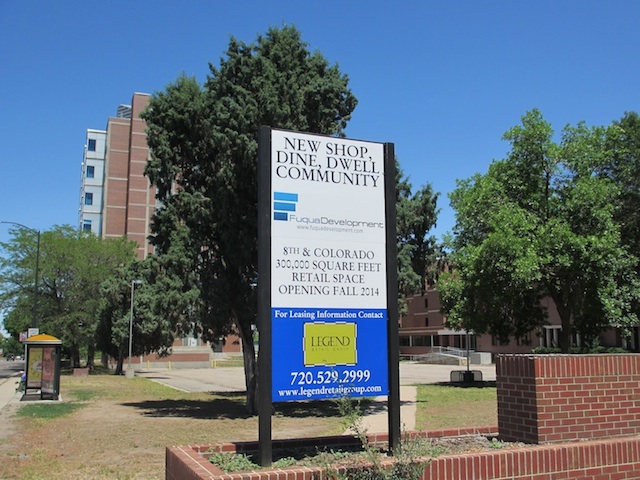
New Sign at 9th and Colorado Indicating the Change in Development Company (D. Saitta)

First, the developer Jeff Fuqua broke away from Sembler and started his own company, Fuqua Development, taking several Sembler personnel with him.  The Denver Post and Denver Business Journal have the story.

Second, the California specialty grocery store chain Trader Joe’s announced that it intends to purchase a property at the corner of 8th and Colorado, just across the street from the development site chronicled here. This will be the first Trader Joe’s store in Denver.  The Denver Business Journal has the story.   Trader Joe’s impending arrival has been hailed as good news by everyone I’ve heard comment on it.

Much less welcome is Fuqua Development’s very recent announcement of the identity of the Big Box anchor tenant for 9th and Colorado: a Walmart store, appropriately down-sized to fit with the scale of the development.   Herein lay the controversy, which erupted big time at a special public meeting that the developer held with local neighbors this week. The meeting was called when news about the Walmart choice “leaked” to the press. Representatives from Fuqua, the City of Denver, the University of Colorado, and Walmart joined an overflow crowd of over 200 people for a presentation and Q&A at Christ Church United Methodist.  Stories are in The Denver Post and Denver Business Journal. Among the  citizen concerns:

  • Walmart’s presence doesn’t reflect the desire of neighbors for independent, “upmarket” retail establishments;
  • Walmart’s reputation for questionable business ethics and practices.
  • Fears about increases in crime, decreases in property values, and the closing of mom-and-pop stores that allegedly follow Walmart into a trade area;
  • Walmart’s tendency to  attract a particular “element of people” to the neighborhoods where it is found;
  • Exacerbation of traffic problems on Colorado Boulevard, which is already functioning at full capacity.

Proposed Walmart Location (from Life on Capitol Hill, July 2012)

The exchanges around these concerns were generally respectful, but the public outrage was palpable. Fuqua and Walmart representatives did their best to address them.  Although Walmart was not in the early discussion of Big Box possibilities, Jeff Fuqua noted that at the end of the day it was the only big box retailer willing to comply with significant General Development Plan constraints and costs.  And, that development of the site as a whole depended on anchoring it with a big box store like a Walmart.  He also noted that Sembler/Fuqua developments have increased property values wherever they appear and that there’s no reason to believe that things would be different at 9th and Colorado.  The Walmart representative was armed with talking points to counteract the widespread public perception that Walmart is a particularly ruthless corporate predator that leaves human devastation in its wake.

The traffic concern is also widespread and will require a separate public meeting. However, I couldn’t help but note a bit of citizen hypocrisy on this point.  The traffic load on Colorado Boulevard is a real and compelling concern.   But interestingly there was no mention of the very strong likelihood that Trader Joe’s—whose presence seemed to be unanimously welcomed by the assembled citizens—will  attract significantly more people and cars to the neighborhood than a Walmart or any other retailer at 9th and Colorado (a debate is here).  The Trader Joe’s customer base is likely to come not only from the greater Denver metro area but also from  a good bit of eastern Colorado and western Kansas.  Is there a double standard at work here?

Public Meeting to Discuss Development of 9th and Colorado, Tuesday, June 26, 2012 (Cyrus McCrimmon, The Denver Post)

I’m interested in this development because it’s near my house and I drive past it often. Thus, I’ll patronize it.  As previously expressed on this blog it would be nice to see an infill development that breaks the architectural mold (e.g., see here and here), but I don’t have a dog in the hunt.  I don’t like what I know about Walmart’s business practices and I consciously avoid the place. At the same time, the Walmart representative acquitted himself very nicely in front of a very hostile audience.  I found myself keeping an open mind about the company’s intentions to adopt a position of “co-tenancy” with other retailers and to stock higher-end merchandise that would serve some local desires.

Conceptual Rendering of Walmart Store at 11th and Albion (SEM Architects)

The comment about the kind of human “element” that Walmart attracts is of particular interest to us urban anthropologists. This was the rhetorical flourish that provoked the most interesting exchanges of the meeting.  One attendee pointedly asked what “element” meant.  Are we talking code for black and brown people?  That suggestion was vigorously shouted down.  One respondent suggested that “element” simply refers to the kind of person who would shoot a Denver police officer.  These were awkward moments.  Only much later in the meeting did one speaker lecture the crowd to avoid “elitism” and stay focused on Walmart’s business practices. This was good advice, especially given the institutional setting: Christ Church United Methodist is committed, among other things, to “cultural inclusiveness.” But the damage had been done.

The demography of the crowd was striking. It was overwhelmingly white (say, 95%) and, by all indications, well-heeled.  This picture is consistent with the Hilltop neighborhood located just to the south of the development site which, according to Piton Foundation census data (which I cross-checked against other sources of census data), is 85% white with an average household income of $117,835.  The Hale neighborhood located just to the north, however, is nearly 30% non-white, with an average household income of $54,830 (a bit below the overall Denver average of  $55,129). About three times as many individuals and families live in poverty in Hale as compared to Hilltop. Thus, Jeff Fuqua has a point when he suggests that the public meeting drew a particular segment of the local population.  The local census data lend credibility to Fuqua’s claim, reported in The Denver Post, that his pro/con emails are running “about 50/50.”   The data also suggest that there’s a demographic–both white and non-white–in the immediate area that would welcome and sustain a Walmart. It’s also important to keep in mind that public meetings of the sort held this week are probably not the kind that would attract strong minority participation.  Thus, it’s imperative that the developers and planners set up meetings in other venues and in other forms by which citizen input from a broad cross-section of neighbors can be solicited.

Finally, I was struck by the frequent appeals of attendees to the “spirit of community”  and how Walmart is in deep conflict with that spirit.   This reminded me of the geographer David Harvey’s classic statement about the rhetoric of community that’s used by some planners and developers (e.g., the New Urbanists) to justify a particular kind of “urban village” development.  Harvey’s words  seem pertinent given what was expressed at the public meeting (emphasis added):

Community has always meant different things to different people…the idea attracts, drawing support from marginalized ethnic groups, impoverished and embattled working-class populations…as well as from middle- and upper-class nostalgics who view it as a civilized form of real estate development encompassing sidewalk cafés, pedestrian precincts, and Laura Ashley shops.  The darker side of this communitarianism remains unstated: from the very earliest phases of massive urbanization through industrialization, “the spirit of community” has been held as an antidote to any threat of social disorder, class war, and revolutionary violence. “Community” has ever been one of the key sites of social control and surveillance, bordering on overt social repression. Well-founded communities often exclude, define themselves against others, erect all sorts of keep-out signs (if not tangible walls)… “Racism, ethnic chauvinism, and class devaluation…grow partly from the desire for community” such that “the positive identification of some groups is often achieved by first defining other groups as the other, the devalued semi-human.” As a consequence, community has often been a barrier to rather than facilitator of progressive social change… All those things that make cities so exciting–the unexpected, the conflicts, the excitement of exploring the urban unknown–will be tightly controlled and screened out with big signs that say “no deviant behavior acceptable here.”

Harvey goes on to suggest that the rhetoric of community and its associated “place-based civic pride and consciousness” serves those who don’t really need it, while those who do are abandoned to their “underclass” fate.  Harvey’s analysis might be a little over-the-top for the conversation about what should happen at 9th and Colorado.  But then again it might be spot-on, given (1) comments made at the public meeting about the kind of person who shops at Walmart, (2) the tacit assumption of many citizens who spoke at the meeting that they spoke for the community, as if community is a singular thing, and (3) the expressed desire by some in the crowd that they’d like to see 9th and Colorado become another Cherry Creek.  Only a couple of citizens at the public meeting invoked the spirit of compromise that’s required to get anything done these days, including the task of replacing a decrepit and rapidly decaying hospital campus with an active public place.  Indeed, writing at the same time as Harvey the great American pragmatist philosopher Richard Rorty suggested in his Achieving Our Country that adherence to fixed principles can, at times, be as much a problem as philosophical wishy-washiness. He notes that in democratic societies “you often get things done by compromising principles in order to form alliances with groups about whom you have grave doubts.” Compromise might in fact be the most appropriate spirit to carry forward if the multiple communities that have a stake in what happens at 9th and Colorado are to be served.

Calibrating for Culture: The Congress for the New Urbanism 20 Years Later

Posted by Dean Saitta on June 17, 2012
Intercultural City, New Urbanism, Urban Studies / No Comments

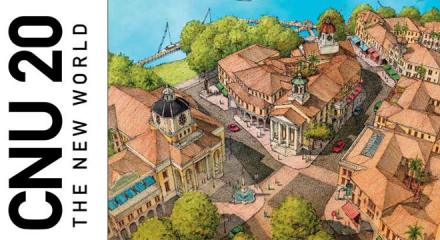
The 20th annual Congress for the New Urbanism recently wrapped up in West Palm Beach, Florida.  I’ve never been to the Congress—and I didn’t attend this one—but I’m always interested in what transpires.  A few summary reports by attendees provide a pretty interesting picture of where this most influential of contemporary urbanisms stands after a generation.   What are CNU 20’s key takeaway message(s)?

Several commentators  detail CNU’s accomplishments of the last 20 years (e.g., here). These include compilation of a robust body of knowledge about compact, mixed use, and walkable town-making and a SmartCode for realizing New Urbanist ambitions in the real world.  New Urbanism has also produced some fine-looking communities on suburban greenfield sites both in the United States and abroad.   On the other hand, New Urbanism has enjoyed less success working in brownfields and city centers, especially in ways that seamlessly integrate new developments with the older urban fabric (see here for a good discussion). There are too few New Urbanist projects that, as Peter Katz says, “disappear into their surroundings.  Too much New Urbanist architecture is kitschy, characterized by “cartoonish, low quality finishes.”  Too many developments bring gentrification, thereby reinforcing the criticism that New Urbanism serves only a particular, relatively well-heeled demographic (but see here for an alternative view).

Thus, there’s good reason for a couple of commentators—here and here—to suggest that CNU must renew attention to the diversity highlighted in the first paragraph of its governing Charter:

The Congress for the New Urbanism views disinvestment in central cities, the spread of placeless sprawl, increasing separation by race and income, environmental deterioration, loss of agricultural lands and wilderness, and the erosion of society’s built heritage as one interrelated community-building challenge.

The separations of culture, like those of race and income, should also be on the agenda.  This raises the question of whether the New Urbanist SmartCode can deliver culturally-sensitive design.  This question was thrown into particularly high relief at CNU 20 by Daniel Solomon and Andres Duany.  Video of their plenary session is here and a good summary is here.  Solomon is an erudite critic of the New Urbanist SmartCode; Duany is a passionate defender.  Solomon argues that the “reductive certitude” of codes  can easily produce “stylistic straightjackets” and ”architectural righthink” that preclude the production of built forms that are compatible with local context, history, and cultural meanings.  Duany essentially countered by arguing that while we can’t always live with codes, neither can we live without ‘em.  He extolled the benefits of having practice governed by known rules rather than the varying opinions of committees and bureaucrats.  He insisted that the SmartCode allows freedom to calibrate plans in ways that accommodate the local and the contextual.

SmartCode Table of Thoroughfares (Duany Plater-Zyberk & Co.)

Duany is persuasive in arguing that there’s no necessary contradiction between coding for conditions and calibrating for culture.  The SmartCode allows multiple ways to “escape” when confronted with cultural difference.  The problem lies not with codes, but with the vision (or lack thereof) of practitioners.  I’d add that any vision must reflect a nuanced and consistent understanding of culture; that is, a refined cultural and intercultural sensibility.   The extent to which planners and architects of any stripe, and not just New Urbanists, have such a refined sensibility  is unclear.  Cultivating one may depend on their ability to distinguish between diversity and difference, or what might be termed “Big C” and  “little c” culture.

Daniel Solomon clearly moves New Urbanist theory and practice in the right direction.  His CNU 20 speech echoes many contemporary anthropologists in finding fault with grand, abstract systems of theory as frameworks for understanding and intervening in the world.  Indeed, Solomon makes good use of  the anthropologist James Scott’s criticism of “universalizing prescriptions” of the sort that produced Brasilia.  But I also heard Solomon unconsciously channeling the great interpretive anthropologist Clifford Geertz in calling for greater attention to the particular details of place and history, local frameworks of meaning, and the need to replace great abstractions of urban planning with a “feel for the subject.”  The following riff from Solomon is especially nice in capturing this ethos:

“If New Urbanists care about sustainability, the sustainability of urban culture should be our first order of business. The way they cook stews and make music in New Orleans, the way they dance in Havana, the way they dress in Milano, the way they use language in London, the way they look cool in Tokyo, the way they wisecrack in New York. Those are things for us to care about.”

Solomon followed up by noting that the court and garden housing ordinance that he helped write in Pasadena, California can’t be straightforwardly reproduced just anywhere.  Rather, it’s a particular housing typology that’s inspired by a particular place and a particular history. This is all good stuff. However, there’s still some reductive generalizing at work here. For example, who is the “they” in the excerpt above? Certainly, “they” doesn’t include everyone who contributes to the dynamic of culture in particular times and places.

Interior Courtyard, Vista del Arroyo Bungalows, Pasadena (Moule and Polyzoides)

Like Solomon’s, Duany’s talk clearly demonstrates an awareness of the importance of incorporating local culture into the practice of placemaking.  Solomon compliments Duany for his insightful observations of New Orleans culture during his post-Katrina work in the city; i.e., for his “feel for the subject.”  But in his CNU 20 speech Duany rhapsodizes about culture in a very different way that contradicts such a nuanced appreciation and is troubling for its reductionism (it also nicely illustrates Solomon’s other point that Duany is a man uniquely capable of holding two opposing views simultaneously):

“There are two ways of being…a kind of Northern European way in which discipline allows the accumulation of wealth. I suppose this has to do with the harvesting of wheat for the winter.  But in the South, where there’s always a mango available—at close reach—the ideal is to accumulate leisure.”

Such broad distinctions are jarring and disturbing, even if used only as descriptive conveniences.  They don’t respect the  many details of local culture and history that shape different “ways of being.”  Such distinctions lend themselves far too easily to unsavory uses.  For example, in listening to Duany I was reminded of Richard Lynn, a very controversial investigator of racial differences who sees Southern peoples as intellectually and culturally inferior to those of the North because of what he takes to be the differing cognitive demands of food-getting in Northern and Southern environments. In other words, for Lynn wheat harvesting produces intelligence whereas mango collecting encourages sloth. The political scientist Lawrence Harrison doesn’t do much better with the basic distinction he draws between progress-prone and progress–resistant cultures.  Urban planning and design, among many other enterprises, is not well-served by such reductionist frameworks for thinking about cultural diversity and difference. Until New Urbanists get some clarity about the nature, sources, and salient dimensions of different ways of being as they exist in the world “Culture” will continue to be the 800 pound gorilla in the meeting room.

Average IQ of Indigenous Populations According to Lynn

In short, New Urbanism has not yet saved the world.   There’s disagreement about whether it is, in any way, still “New.”  It is certainly at a tipping point, with some significant challenges on the horizon.  Can New Urbanism colonize urban centers in ways that strengthen urban fabrics?  Will it calibrate for real, meaningful cultural diversities and differences? Are its built forms capable of  accommodating cultural change, cultural mixing, and spontaneous cultural interventions?

The 2013 Congress for the New Urbanism will meet in Salt Lake City and Duany, for one, can’t wait. His plenary address complimented the late 19th century Mormon system of town planning—the “Mormon Block“—for its flexibility, adaptability, and openness to calibration.   Duany is careful to separate Mormonism as a system of ideas from Mormonism as a set of religious beliefs.  However I’m not sure this separation can be so easily maintained, especially if we respect the power of cultural difference.  The Mormon way of being is historically predicated on some basic articles of cultural faith: individual self-sufficiency, well-ordered regularity, separateness of Mormon (Us) and Gentile (Them), and domination (rather than stewardship) of Nature as a way to achieve personal redemption.  Not all cultures subscribe to these principles.  Mormons are also known for their exquisite ability to live with the contradictions inherent in their way of being; e.g., between their belief in biblical literalism and their healthy respect for modern science.  The Salt Lake City Congress promises an interesting excursion into territory that will likely continue to test the faith of New Urbanists in their own theories, practices, and ways of being.

Revisiting Pruitt-Igoe

Posted by Dean Saitta on June 06, 2012
Architecture, Pruitt-Igoe, Urban Studies / 1 Comment

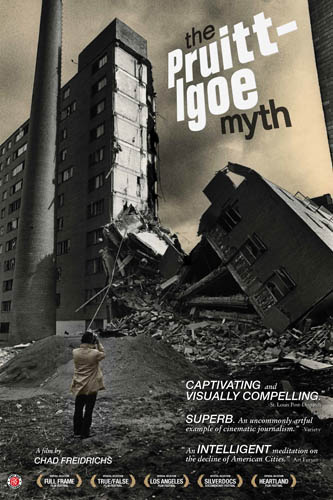
Back in November 2011 I wrote a review of Chad Friedrichs’ film The Pruitt-Igoe Myth.  I’m prompted to revisit the subject because of a very nice analysis of the film by Ray Gindroz  that recently appeared in Better! Cities and Towns. Mr. Gindroz is a  man with lots of credibility given his long history and deep experience designing mixed income housing and Hope VI projects.  He’s also been identified as one of New Urbanism’s leaders in developing quality infill projects for  urban cores.

I’m pleased to see that Mr. Gindroz’s  analysis of the film, including key takeaway lessons, broadly converges with mine.   Pruitt-Igoe’s history was shaped, in Gindroz’s words, by “the macro-economic and social conditions of the postwar period.”  Likewise, its demise was the  result of a “perfect storm of economic change, crushing policy decisions, and over-reaching ambition.” Most importantly, Gindroz sees design and architecture as playing distinctive roles in Pruitt-Igoe’s history.  In my original review I said this about that:

I certainly agree with the importance of …economic and institutional forces…in determining Pruitt-Igoe’s fate.  But given the importance of architecture in human affairs and, especially, its role in transforming built space into owned place  it seems short–sighted—and inconsistent with any explanation that invokes “complexity” of cause—to rule it out completely.  Mention is made … throughout Friedrichs’ film, of how various design elements conspired against residents…. In [some] sense…architecture is the most important causal factor in Pruitt-Igoe’s story because it’s the one variable that was always under some sort of direct human control.  Pruitt-Igoe’s architects were clearly working under strict constraints imposed by the St. Louis Housing Authority.  But the design team consciously opted for the modernist program when other choices were available… Erring too much on the side of [economic and institutional] causality risks absolving these agents of too much responsibility…Perhaps the most important lesson of Pruitt-Igoe is that we should always and everywhere see the life and death of buildings as complexly overdetermined in ways that encourage us to take greater responsibility for those things in life that we can, in fact, influence and control. Today architects are increasingly taking advantage of their power of choice …to design affordable housing that’s more livable and lovable.

Gindroz frames his own viewpoint this way:

I would argue that the problems were caused in part by housing policies and in part by failures of urban design and architecture. Our profession is not helpless in the face of these issues. In fact, Pruitt-Igoe’s spectacular and much-publicized failure caused all those involved with housing and cities to rethink how to provide low-income housing and how to redevelop failing parts of cities. In the years since Pruitt-Igoe came down, major reforms have been put in place. One lesson is that  it is essential to build neighborhoods not just housing.

Gindroz closes his review by describing some recent efforts to “build neighborhoods” that include his own post-Katrina work at Faubourg Lafitte in New Orleans (see also here).  In so doing he notes another lesson still to be learned from the case of Pruitt-Igoe: “how to find the right balance between expansion of cities and reinforcement of their centers.”

Faubourg-Lafitte, New Orleans

Surprisingly, given the popularity of the Pruitt-Igoe story and the status of the reviewer, Gindroz’s Better! Cities and Towns article drew only two comments. But they are doozies.  Even though the two commenters are diametrically opposed in their opinion of the film and Gindroz’s review, both  seem determined to perpetuate the myth that Friedrichs’  film was purposely  intended to bury: that Pruitt-Igoe’s disintegration was the fault of black culture and the absence of proper middle-class values.  Commenter Ralph Bennett says (emphasis added) that:

Ray makes many excellent points, including the quite correct New Urbanist criticism of superblock planning. But the real death knell for P-I came from the Brooke amendment to the public housing law which required lowest income families to be served first, insuring over-concentration of stressed families in an environment which required supervision. The circulation arrangements of P-I didn’t work for this population, but remain innovative and useful for mid- and high-rise housing, in my opinion.

Commenter Alan Potkin follows up with this (emphasis added):

Far too much a white-guilt driven apologia for the dysfunctional and sociopathic urban underclass…When I was a grad student at UC Berserkeley in the 1980s, I lived in a crapola university-owned off-campus housing complex –since demolished– which was too declassé for most bourgeois Americans (it was recycled WW2 shipyard worker housing!); and so was occupied mostly by foreign student families, who weren’t necessarily of such elite backgrounds themselves, but they certainly had high aspirations and considerable levels of achievement… The place was impeccable! An absolutely identical complex –in architectural design, construction, units-per-acre density, land-use, and all other physical conditions– down in Alameda and run as, I recollect, by a public housing agency, had devolved into a vicious slum. Hmmmm. I wonder why that was?

Potkin also adds a link to a website that apparently has, as one of its goals, to explain urban blight and failed public housing in terms of the inferior and ineluctable biology of inner city residents (i.e., blacks) compared to whites and, presumably, “high aspiring” foreigners (of Asian descent, perhaps??).

I’ll forego rehearsing the abundant, well-evidenced arguments from anthropology and other disciplines demonstrating that human biology can’t explain the social and geographic distribution of poverty and other human miseries.  Potkin’s comparative building example is also problematic because one housing project no longer exists, the other isn’t identified, and I suspect that neither can be confidently remembered in all of their important details.  On the other hand, we do have a credible comparative touchstone for Pruitt-Igoe that implicates the relevance of architecture and design to building sustainable affordable housing.  As noted in several reviews of Friedrichs’ film the nearby Carr Square Village—a low rise, lower density development with a comparable demographic makeup that was built in 1942—did not suffer from the vacancy and crime that afflicted Pruitt-Igoe.

Child at Pruitt-Igoe

More importantly, though, I don’t see how anyone can watch Friedrichs’  film and not be impressed by the insight and intelligence of the former Pruitt-Igoe residents who were interviewed.  These people don’t strike me as members of a population that’s inherently dysfunctional, or sociopathic, or in need of constant adult supervision.  I think those qualities are to be found elsewhere.

Venice in a Day…And for a Week Later this Month

Posted by Dean Saitta on June 03, 2012
General, Intercultural City, Urban Studies / No Comments

I came across this video by Joerg Niggli while checking in on Kaid Benfield’s blog, who had come across it while checking in on The Urbanophile.  It’s called “Venice in A Day”:

I’ve visited Venice before, as part of a Grand Tour honeymoon in 1996.  Happily, I’ll be re-visiting the city later this month for a Seminar on “Intercultural Urban Planning and Placemaking.” The seminar is sponsored by the Council of Europe’s Intercultural Cities Programme and will be held at the Università IUAV di Venezia, 21/22 June 2012.  From the seminar’s preliminary  program:

We shape our cities and our cities shape us.  Europe’s towns and cities are now more diverse in terms of ethnicity, language and religion than they have ever been, and the trend is upwards. 

The Intercultural Cities project is predicated on the belief that this presents not a threat but an opportunity, but that cities must be smart and strategic if they are to realize this diversity advantage. Our streets, squares, parks, markets and public buildings will be the places where strangers are most likely to encounter one another, so the people who plan, design, build and manage them have an important responsibility. An ill-considered public space can discourage conviviality or even exacerbate tension. However, there are now many examples of urban spaces that are welcoming, reassuring and stimulating, which enhance our natural curiosity and sociability and help to build a sense of intercultural familiarity and citizenship.

The seminar will be a meeting of leading academics and practitioners from cities within the Intercultural Cities network. The aim of this unprecedented event is to highlight and share some best practice principles and practices which will lead to positive innovations in our European urban spaces.

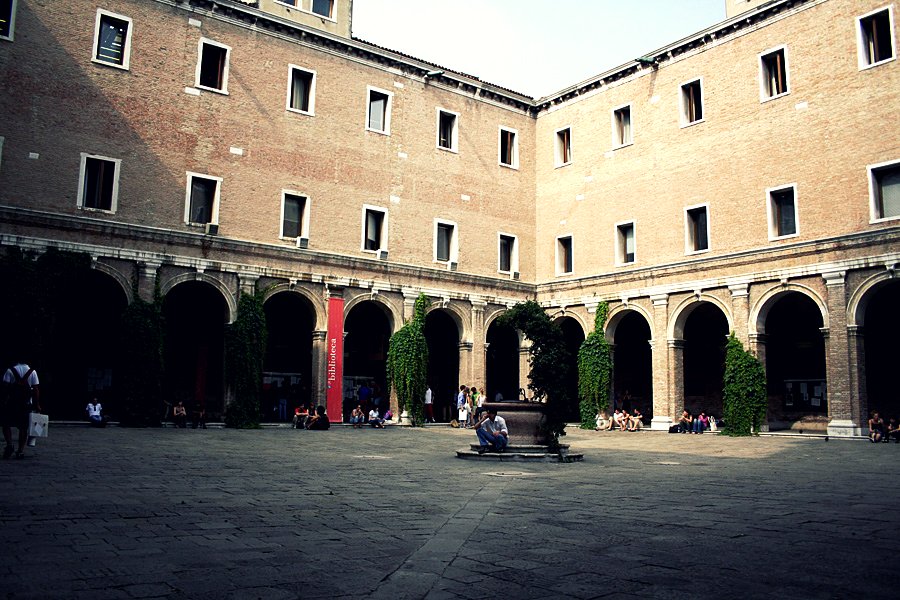
Università IUAV di Venezia (Mused’s Photostream, flickr)

Venice is a perfect choice of location for these conversations, as is The Università IUAV di Venezia.  This is from the University’s promotional material:

The IUAV has three faculties – Architecture, Regional Planning, and Arts and Design –all of which have grown out of the original School of Architecture (founded in Venice in 1926). In recent years the IUAV has implemented a unique experiment in “project-based learning” that is the first of its kind in Italy. Theory and technique are integrated with hands-on training that spans the entire planning and design process, from the conception of an idea all the way through to its realization… [The IUAV] is the only university in Italy entirely devoted to teaching the planning and design of everything related to the spaces and environments in which we live: buildings, cities and landscapes; objects of daily use and graphics; cultural, theatrical and multimedia events.

I’m very grateful to Phil Wood for inviting me to participate in the Intercultural Placemaking seminar.  And, I’m grateful to Mr. Niggli for his fine putting-in-the-mood video.  A calendar of other Council of Europe Intercultural Cities meetings in 2012 is here.