Monthly Archives: February 2012

Citizen Input on 9th and Colorado: Architectural Form

Posted by Dean Saitta on February 18, 2012
9th and Colorado / No Comments

This series of posts has been chronicling the development of the old University of Colorado Health Sciences Center site at 9th and Colorado, a relatively small (28 acre) site that’s being developed as a mixed use urban neighborhood.  Attending the public meetings about the project has been a great opportunity to learn about what’s involved in moving an urban infill project from idea to reality; for example, about General Development Plans, Design Standards and Guidelines, and the latitude that developers have for “place-making.”  It has also been a terrific opportunity to take the pulse of what citizens value in their urban environments and what they take to be the “good city.”

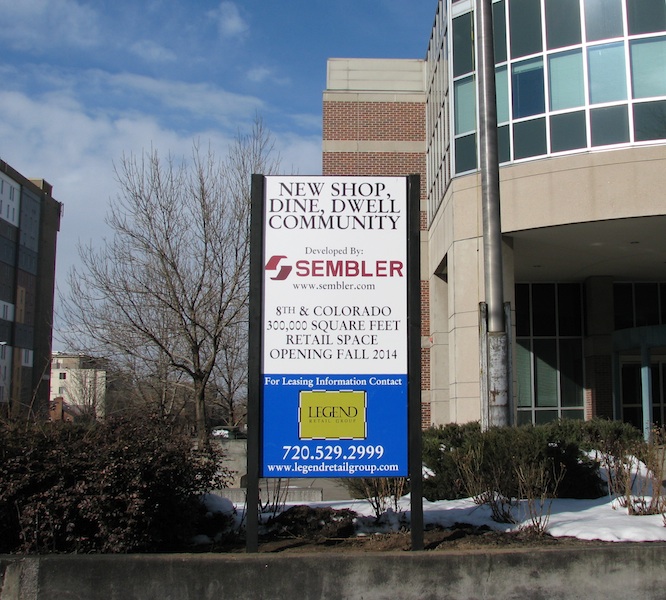
Sign at Corner of Colorado Boulevard and 11th Avenue (D. Saitta)

The Colorado Boulevard Health District Board meeting and public hearing on February 2 offered some new conceptual renderings of arguably the two most significant aspects of the 9th and Colorado project, the Large Format (Big Box) retail store at 11th and Colorado, and the 8th Avenue edge, or what’s been dubbed “Restaurant Row.”  These latest renderings were shaped by citizen input from the adjacent Bellevue-Hale neighborhood.  The Big Box store, as shown and described by the project architect, will incorporate several different architectural “looks” to break up the built mass that’s required to contain 100,000 square feet of retail space.  These include  monumental stairs, terraces, grade changes, and other features designed to periodically alter the “rhythm” of the building.  This sounds very good in theory.  After viewing a few conceptual renderings, however, one citizen  commented that the imagined building still looks “blocky,” “closed”, uninviting, and institutional– reminiscent of a “high school.”  Nothing has been finalized; project managers wryly intimated (and I sympathize!) that presenting, for public comment, conceptual drawings that are still very much works in progress is one of life’s no-win propositions.

Conceptual Rending, 8th Avenue “Restaurant Row” (Sembler)

Revised drawings for the 8th Avenue edge (above) met with a little more citizen enthusiasm.  The plan here is to offer a mix of modern and traditional (i.e., turn of the 20th century) building styles that will break up the long block and also create a sense that the area grew “organically” over time instead of all at once.  There’s also a concern to provide some contrast with the Big Box building.  Denver’s popular Old South Pearl Street was mentioned as one existing model for what’s desired.

Old South Pearl Street, Denver (D. Saitta)

The project architect is happy with the way that the 8th Avenue piece of the development is coming together as an exercise in “place-making”. What struck me, however, is that no mention was made of the specifics of this place nor of its history as a Health Sciences Center.  It seems that any serious effort at place-making should take these specifics of history into account.  Certainly the preserved Nurses Dorm provides one touchstone, but nary a mention was made of it…unless it’s taken-for-granted that this is the kind of early 20th century building style to be emulated.  For their part, assembled citizens commented that they “don’t want stucco”, and would like the developer to avoid anything that looks like the Colorado Pointe apartment buildings located directly across  Colorado Boulevard.  I’d add that it might be nice to consider something iconic along with the traditional and contemporary, if the area is to be more visually interesting than the other architectures that are currently infilling Denver. Sembler Company is keen to receive more citizen input about architectural look.

Nurses Dorm (D. Saitta)

The other major topic for the meeting was a transportation analysis update.  As noted in previous posts, projections suggest that there will be much less traffic moving into and out of the site compared to when it was used as a Heath Sciences Center.  Denver Public Works and Planning personnel provided some interesting comparative data on anticipated number of trips into the site plus expected numbers of additional cars using adjacent off-site streets.  Daily car trips into the site when it was used as a Health Sciences Center numbered 27,392. The original developer—Shea Properties—anticipated 19,864 daily trips for its planned development of 1 million square feet of retail space.  The current, less dense Sembler plan  (300,000 square feet of retail space) anticipates 13,991 daily trips.  Thus Sembler expects ½ the number of car trips into site as whole compared to its old use.

Citizens, however, remain concerned about the accuracy of these numbers and ask whether Sembler has a track record for delivering projects that don’t exceed traffic projections.  They’re especially  concerned about traffic volume on specific residential streets that will feed into the project from the south of 8th Avenue (for site plan go here).  Denver traffic engineers predict that these streets will carry between 170-280 more cars per day  than currently.  The chief concern for local parents is that these streets have lots of kids walking to a local elementary school.  Several of these streets also lack sidewalks, forcing pedestrians to walk in the street.   These observations produced some interesting back-and-forth.  Several well-informed and well-spoken mothers channeled their inner Jane Jacobs to press Denver officials on the arrangements that would ensure  kid safety. The traffic engineers insist that their first concern is always safety. They offered  comparative vehicle counts for  “typical” Denver streets that are a lot higher than for those  around 8th and Colorado.  Project managers also reminded the audience that the key planning goal for this development is to restore the street grid and the site’s connectivity to the surrounding area.  Citizens support that, but not at the expense of pedestrian safety.   It was noted that if development is successful beyond expectations—certainly a developer goal!—then there could be more traffic than anticipated (but see here for an account of how the Big Box store might offset these increases by encouraging residents in the vicinity of the project to walk much more).  In short, citizens asked city officials to consider incorporating more “traffic calming” measures around the site.  This request was well received: public works people will meet with residents to talk about the measures that could be taken to maximize pedestrian safety.

The next meeting of the Colorado Boulevard Health District Board will be Thursday, March 1 at 4:00, Molly Blank Conference Center of National Jewish Hospital.

Educating for Urban Sustainability…And Remembering Doug Darden

Posted by Dean Saitta on February 03, 2012
Architecture, Sustainability, Urban Studies / 1 Comment

The Chronicle of Higher Education, to which I’m a long-time subscriber, channeled its inner urbanist last week with three city-related articles in the January 27 edition.

Scott Carlson wrote about “America’s Health Threat: Poor Urban Design.”  He featured the work of  Richard J. Jackson, former head of the National Center for Environmental Health at the Centers for Disease Control.  In print and on public television Dr. Jackson has alerted citizens and policy-makers to how the American built environment is making us fat and killing us–literally. Dr. Jackson’s prescription going forward is to build for better social connectivity and in ways that encourage physical activity.  New Urbanism is mentioned as one viable approach for filling this prescription.

Nigel Thrift,  Vice-Chancellor of the University of Warwick in England, contributed an opinion piece called “The Pull of Cities.”  He suggests that we need a sea change in the way we think about cities now that over half the world’s population lives in them.  Dr. Thrift sees cities as “increasingly both networked and perforated by information technology in ways which are bringing them together as actual forceful entities rather than as simply conglomerations.” He urges us to “grow a distinctive urban science” oriented around information technology that reunites the technological and the social.  This will involve changing the university’s curriculum to better integrate the natural sciences with the social sciences and arts and humanities, and perhaps changing the university itself.

Dave Plunkert for The Chronicle Review

Finally, Jon Christensen, Robert McDonald, and Carrie Denning build upon the education theme by calling for an “Ecological Urbanism for the 21st Century.” The key takeaway message is to do more integrative, interdisciplinary work, as Dr. Thrift suggests. Minimally, there’s a need to integrate urban planning with ecology and conservation science.  But there’s also a need to go beyond. Margaret O’Mara, co-organizer of the “Now Urbanism” seminar at the University of Washington, suggests that both urbanists and scientists “pay too little attention to politics, economics, and history” in designing cities.  I’d add that they also pay too little attention to culture. Attending to all of these variables is critical if urbanists are to better root their dreams and plans for re-making  neighborhoods in what O’Mara describes as “what is already there.”

The last time The Chronicle prominently featured architectural design and training in such a way was with a long article by Sarah Williams Goldhagen nearly 10 years ago called “Our Degraded Public Realm: The Multiple Failures of Architecture Education” (but see also this piece by David Orr).  Goldhagen hit some of the same notes about form, context, and curriculum as Thrift and Christensen et al., including this key money quote:

What do graduate programs in urban design, and especially in architecture, teach? Although they vary from institution to institution, certain commonalities exist. One is that such programs generally give short shrift to the study of sociology of urban and suburban life, leaving students without the knowledge or tools to understand the environments for which they design. As a result, students tend to focus their ideas overwhelmingly on forms, with little informed awareness of how their buildings will contribute to a larger urban composition and to the social existence of communities.

While Goldhagen called for more training in the pragmatic aspects of design, she also implicated the need for more interdisciplinary work.  It’s interesting that her recent piece in The New York Times linking architectural form to the visual metaphor of the tree as shelter walks that talk.  Goldhagen calls for an engagement between design disciplines and the revolution in cognitive neuroscience; that is, for re-conceptualizing the built environment around the fundamental workings of the human mind. I suspect that Nigel Thrift would approve.

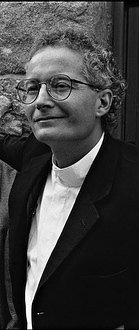
Douglas Darden (Ben Ledbetter)

I’ve had my own brush with the issues at stake in these various essays.  In 1994 I gained some experience jurying student architectural projects at the University of Colorado-Denver’s College of Architecture and Planning.  The design studio was taught by a Special Lecturer in Architecture and Fellow of the American Academy in Rome named Douglas Darden.  Doug died prematurely from leukemia in 1996, at age 44.  At the time Doug was known to be a very  creative thinker and inspiring teacher.  I met Doug through my girlfriend Martha Rooney (now Martha Rooney-Saitta) who had taken a studio with him.   Doug—open-minded thinker that he was—thought it would be interesting to have an anthropologist on the jury in order to balance, complement or—perhaps ideally—contradict the opinions of the practicing architects and professors of architecture.

The jury I sat on was for a project that Doug called “Ghosts.”  I regret that I can’t remember the specific design challenge that Doug set for his students, but the students produced work ranging from a neo-modernist development that riffed on an Ancient Pueblo Indian theme (which pleased me greatly given that my academic reputation, in an earlier life, was gained as a North American archaeologist) to a modernist high rise with a huge, retractable mechanical claw that emerged from its middle stories.  I remember interpreting the latter as a philosophical critique of the modernist project—an observation that escaped the professionals on the jury but that the student designer confirmed was his primary intention.  In fact, in this student’s view the anthropologist was the only juror who “got it.”

Jurying was great fun and also confirmed that anthropologists (and other students of culture) can make distinctive contributions to the design professions.  Nonetheless, I came away with the distinct impression that for students and professionals alike architecture was– as Goldhagen would note nearly 10 years later and Thrift nearly 10 years after that– largely about technical form and not so much about social context; that it was largely perceived as a technical challenge rather than a social opportunity.  That experience has always stayed with me and continues to be the touchstone against which I evaluate proposals for remaking the human built environment.

After reading the Chronicle articles I googled Douglas Darden.  I was happy to find a 1998 article by Jean LaMarche in Utopian Studies called “The Life and Work of Douglas Darden: A Brief Encomium.”  The article focuses on the contents of Doug’s 1993 book  Condemned Building: An Architect’s Pre-Text.  The book contains 10 imaginary projects dealing in “unfulfilled desire” as well as death (Doug’s own was not far off), which perhaps explains the “Ghost” theme of the studio that I juried.  The most critically acclaimed project in the book is Oxygen House.  This is a house designed  for a person Darden calls Burnden Abraham (based on a character in Faulkner’s As I Lay Dying), an invalid who needed to be housed in an oxygen tent.  Like his students Darden sought to interrogate the modernist project, in this instance turning modernism on its head by casting architecture not as “machine for living” but as a “machine for dying.”  In so doing Doug provides a useful counterpoint to the kind of designs for urban health championed by Dr. Jackson.

Oxygen House (Douglas Darden)

LaMarche’s characterizations of Doug’s work (three of which I excerpt below) helped me better understand why I liked Doug and found his studio so energizing.  And, more importantly, why I believe that good urbanism should incorporate an architecture of possibility that’s informed by culture, history, mortality, and the many other dimensions of human social life. LaMarche writes:

[for Darden] architecture is fundamentally connected to all other human endeavors, all other forms of cultural production. Thus, all human undertakings can be explored as part of it and architecture, in turn, can be examined to shed light on these as well: in all forms of making we reveal some of the most important and at times intransigent questions that humans continue to deliberate. More importantly, we reveal the constant struggle with what is not there and thus, our constant utopian desire or yearning.

And:

Darden had that poetic urge to explore his own demons and, more importantly, to engage in an architecture that did not exclude the other conditions of being human—our fears, our hopes, our dreams, and the necessity for resolve…

And finally:

In the end, Darden extends architecture, makes it larger than it was before him. He does so by demonstrating how architects can successfully draw on a much wider array of artifacts for inspiration and guidance [perhaps like the student who channeled the ancient Pueblo Indians in her final project for “Ghosts”] in the design and production of the material world.